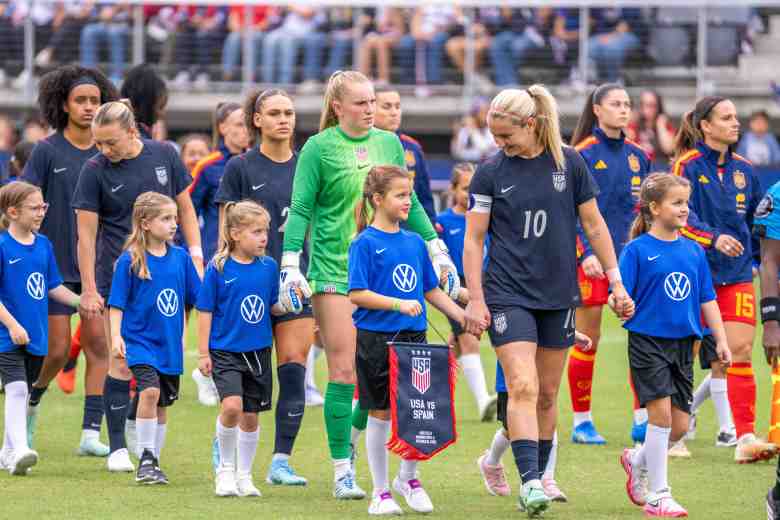
The 2027 FIFA Women’s World Cup in Brazil is just seven months away. On Monday, soccer fans finally learned where the world’s biggest tournament will be held in 2031. FIFA announced additional monumental changes made to the tournament, too.
Here’s a primer about everything you need to know about Monday’s FIFA announcement ahead of the 2031 World Cup.
Who will host the 2031 FIFA World Cup?
The FIFA Members Association awarded the 2031 World Cup hosting privileges to four nations: the United States, Mexico, Jamaica and Costa Rica.
It will be similar to the layout the men’s World Cup had this past summer, as the matches were played across the United States, Mexico and Canada. The four nations sent in a similar bid as the three North American countries did for the men’s tournament.
The United States is hoping to build off of the momentum from last year’s men’s World Cup and the 2028 Summer Olympics in Los Angeles to keep that same level of excitement about soccer through 2031. Three summers of highlighting soccer within five years on the biggest stage in the U.S. gives the country the perfect opportunity to grow the sport nationally.
“This milestone furthers the continued belief that the best days of soccer in America are still ahead,” U.S. Soccer CEO and general secretary JT Batson said in a press release. “We have an opportunity to use the momentum from the 2031 FIFA Women’s World Cup to accelerate our ambitions for the future of soccer, from expanding access and participation to strengthening the pathways that develop the next generation of players. We are excited to work alongside our partners across the region to make this tournament a defining moment for women’s soccer.”
Has the United States hosted the World Cup before?
Next year will mark the third time the United States has hosted the women’s World Cup. The first occasion was in 1999, the third installment of the World Cup. It was a significant year in World Cup history as the tournament expanded to 16 teams for the first time.
Additionally, the ‘99 World Cup still holds the record for the largest attended international women’s soccer match in history, with 90,185 fans watching the United States defeat China PR in the World Cup final at the Rose Bowl in Pasadena, Calif. The USWNT was nicknamed “The ‘99ers” and received international fame because of their win. This World Cup still holds the tournament record for the most average attendees at matches with 37,319.
The U.S. then hosted the tournament again for the fourth edition in 2003 when China PR was originally set to host. The United States only had four months of notice to host, as there was a SARS outbreak in China PR that year. Six different cities hosted the tournament, averaging 21,240 fans per match. Germany won the World Cup title that year, with the USWNT coming in third.

Add Women’s Sports Daily to your routine!
A five-minute daily roundup of the latest headlines in women’s sports from the editorial team at The IX Sports.
Has Mexico, Jamaica or Costa Rica hosted the World Cup before?
The 2031 World Cup will mark the first time each of these three countries will host the tournament. Hosting the tournament allows for more soccer infrastructure to be built in the three countries in the next few years before the tournament. This will likely inspire the sport of soccer to grow in these countries.
“We are incredibly honored and excited to welcome the world to the United States, Mexico, Costa Rica and Jamaica for the 2031 FIFA Women’s World Cup,” U.S. Soccer President Cindy Parlow Cone said in a press release.
“This is a historic moment for our four countries, but the opportunity is much bigger than any one of us. Together with FIFA, we want to deliver the biggest and most impactful Women’s World Cup in history and use its success to accelerate the growth of women’s soccer around the world. Our ambition is to create a tournament that not only inspires millions of players, but helps give them the opportunities to play, grow and pursue their dreams.”
Which cities will host the matches?
The exact cities where the World Cup matches will be played haven’t been announced yet. That will likely come some time next year. For reference, the cities selected for the 2026 men’s World Cup were announced in ‘22, so four years prior.
There were 20 venues proposed when the four nations made their bid. The nations proposed 14 cities in the U.S., four in Mexico, along with San José in Costa Rica and Kingston, Jamaica.

Finding the game shouldn’t be the hardest part
SheScores is the women’s sports scoreboard, making it easy to follow women’s sports with scores, schedules and where to watch — all in one place.
What makes the 2031 World Cup different from years past?
Aside from finding out where the 2031 World Cup will be played, the biggest news coming out of the announcement on Monday was the tournament expansion. FIFA will be expanding the tournament from 32 nations represented (as will be the case next summer) to 48 nations in 2031. This means the number of matches played will increase from 64 to 104 for the first time, matching the men’s World Cup format.
This is a huge and significant change, and also the biggest one the tournament’s ever made. The tournament started in 1991 with 12 teams, then increased to 16 in ‘99, then to 24 in 2005. The most recent expansion came just in 2023 when the field jumped to 32 teams. Just eight years later, FIFA will be adding 16 more teams. The tournament has quadrupled since its creation.
“This is a historic moment for women’s football, and a tremendous achievement for our entire Concacaf family,” Concacaf President and FIFA Vice President Victor Montagliani said via a press release. “… Hosting the first-ever 48-team FIFA Women’s World Cup across four nations is an extraordinary opportunity to showcase the strength and unity of our region, inspire millions of girls, and create a lasting legacy for women’s football across all 41 of our Member Associations. Together, we are committed to making 2031 a defining moment for the growth of our game.”
How will FIFA decide where the new teams come from?
The current format for nations to qualify for the World Cup stems from the six confederations and how they choose to allow teams to earn their spot. For example, Concacaf and CAF (Confederation of African Football) host tournaments within their confederations to hand out a World Cup spot to the winners. Playoff spots for earning a World Cup position are also determined through these tournaments. The USWNT will compete for a chance to earn their spot starting this weekend in the Concacaf W Championship tournament.
Other confederations have different formats for their own tournaments to determine which nations will advance to the World Cup.
The host countries automatically earn a bid for that year’s World Cup, meaning the U.S., Mexico, Jamaica and Costa Rica will all get to compete.
So, where will those additional 16 teams come from? Unfortunately, FIFA hasn’t announced how they plan to determine which confederations will earn more bids, or how those bids will be figured out within the confederations. The confederations may opt to adjust their current formats in order to work better with the expansion.
“The slot allocation for the 2031 and 2035 editions of the FIFA Women’s World Cup will be confirmed in due course by the FIFA council,” a FIFA spokesperson told The Guardian.
Each confederation’s allocations differ each year as it depends on which countries are hosting the tournament, and how big the pool is.

Support 27 in ’27!
Help The IX Sports put a reporter on the ground in all 15 WNBA markets and all 12 PWHL markets in 2027 by contributing to our first-ever year-end campaign.