

LAVAL, QC — “Bonne game!” The shuttle driver’s amusing French-English mashup immediately struck me as très Québécois; why say “game” when “match” is identical across both languages?
Quebec’s language politics feel omnipresent within the province, especially for folks like myself who are not, try as we might, fluent in French. But the linguistic and cultural diversity of Quebec, especially in the cosmopolitan city that is Montreal, is far more delightful and interesting than the province’s French hardliners would have you believe.
The city’s sports teams are a prime example of that. On the Montreal Roses (or should I sayles Roses de Montréal?), for example, there are players from Quebec, other Canadian provinces, South Korea, France, Ghana, and the United States. In the post-match press conference, coach Robert Rositoiu — who moved to Quebec from Romania as a child — flitted easily between English and French. The two players sitting on either side of him, however — co-captain Tanya Boychuk and goalkeeper Anna Karpenko — grew up in Alberta and Ontario, respectively, and only answered questions in English.
At the international level, Boychuk represents Ukraine. (She said that having been in camp with that national team “gives me a different perspective on football, with what those girls go through. They show up every day. They don’t complain. So when I come here and we have everything — everything — provided to us by our staff, and with the facilities, the administration, it just gives me a different perspective on football.”)
All that is to say: perhaps in sports, more than other aspects of Québécois life, the politics of language cedes way for something like community. Everyone, after all, plays for — or cheers for — the same team.
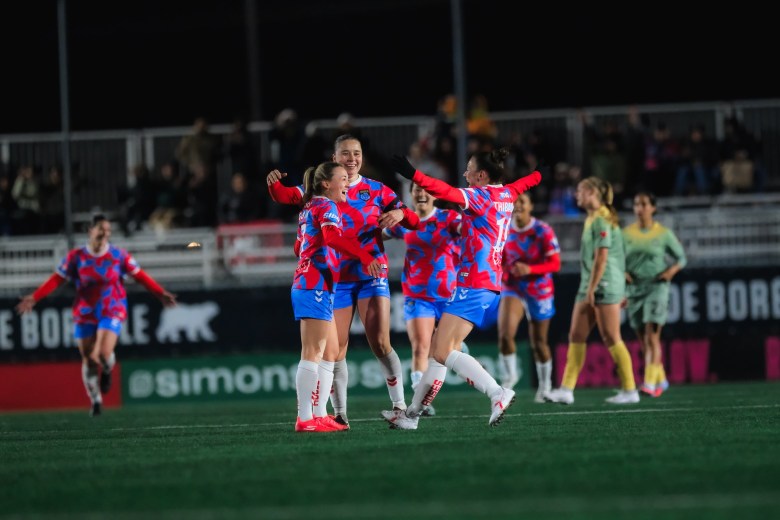
And what a team the Roses are! Saturday night was the club’s home opener in the second-ever Northern Super League (Super Ligue du Nord) season, and they trounced the Vancouver Rise, last year’s championship winners. The 4-0 scoreline was entirely deserved — it’s early days, but the Roses look lethal.
For the first few minutes, the sides looked somewhat evenly matched, but that changed in the 13th minute when Elyse Bennett, the Roses’ biggest offseason signing, headed in a looping cross from former Rise player Lisa Pechersky. Bennett, who previously played in the NWSL and Liga F, scored both of the Roses’ goals in their first match of the season, a 2-0 win against the Calgary Wild. After the match on Saturday, Rositoiu couldn’t praise her enough. “She’s very intelligent to recognize the cues when we want to press. I think she brings a lot of composure; I’m not in there, but I can feel it. And after that, she’s a constant threat from different scenarios,” he said.


The goal gave the crowd energy, and the team took it from there, holding a very high line that made Vancouver struggle to leave their own half. Winger Chaerim Kang was outstanding for Montreal—her speed and technical skill resulted in threat after threat down the right side.
Still, the scoreline remained 1-0 for most of the half, theoretically leaving Vancouver with room to come back. But in the 45th minute, Boychuk made the most of chaos in the box after a corner and pounced on a tap-in. It wasn’t the most beautiful goal, but it was entirely deserved for the dominating Montreal side. Boychuk, ever the showman, immediately did a backflip and continued to pump up the crowd until play restarted.
Boychuk wasn’t done. Just a few minutes after halftime, she found herself in another perfect position in front of the net to redirect the ball with her head after a shot by Bennett bounced off the crossbar. “Honestly, Elyse did all the hard work, so all I had to do is tap it in,” she said after the match. “I couldn’t believe it: I thought it was going in, and then it bounced off and landed on my head. So I got pretty lucky.” Boychuk might say ‘lucky,’ but the best strikers find themselves in ‘lucky’ positions all the time; it takes skill to be where the ball goes, and to have the wherewithal to put it in the net.
Vancouver improved in the second half, but was never going to be able to climb out of a 3-0 hole. Indeed, they only registered one shot on target throughout the game to Montreal’s seven. “I didn’t have much to do, and that’s kudos to the team, the back line, keeping it all together — a proactive defense, in case the ball comes our way,” Karpenko said after the match. “And they honestly made it look really pretty. I was watching more from enjoyment than actual in-game perspective.”

Despite the scoreline, Rise coach Anja Heiner-Møller liked what she saw from her team in the second half. “I do think you saw a team that was working hard … just trying, trying, trying. So that is what you want to see from the team: that response,” she said after the match. “And of course, then that needs to show in the play as well. But it starts with the mentality, and the team stuck together and worked hard.”
For Quinn, Vancouver’s captain and midfield engine, Saturday’s result is no need to panic, even though it came after a loss to AFC Toronto in the season-opener. “It’s a long season. I think there’s still a lot of nerves coming into this. We have some new players, and so I think we’re still creating a cohesive team,” they said. “I don’t think it’s much different from last season. We had a bit of a rocky start, but that’s not to say that’s how the season needs to finish. It’s really early for us. … And we’re going to continue to build, hopefully peaking at the right time.”
But Saturday night was all Montreal, and Noémi Paquin made sure of it. With just a few minutes left of the match, the substitute stripped the ball from defender Jessika Cowart at midfield, and after running just a few yards, spotted keeper Morgan McAslan far off her line. She shot the ball low and with precision, and it scooted past a fruitlessly backtracking McAslan. Imagine Carli Lloyd’s 2015 World Cup final half-field goal (which happened in Vancouver, by the way), but instead of looping above the keeper, the ball skittered in beside her. To make a Quebecois analogy, the goal reminded me of an empty-net goal in hockey. A flourish of dominance, a final nail in the coffin. (The Montréal Victoire, by the way, had earlier in the day fallen to the Minnesota Frost in a bonkers first game of that PWHL semifinal series. I had attended both, along with the teams’ shared in-game host and, judging by the amount of Roses scarves at Place Bell and Victoire jerseys at Stade Boréale, many fans.)
The Roses are off to a hot start on the season. The question, of course, is if they’ll be able to keep it up. Last year, they also began on a strong note, but faltered and only just eked into the playoffs, where they lost in the first round. They’ll hope that the roster can be a little more stable this year; last year’s midseason departure of the club’s leading scorer Latifah Abdu to Vancouver (she was injured, so did not play on Saturday) seemed to destabilize the team. But with the addition of players like Bennett and the retention of the bulk of the roster, the team has a multitude of attacking options. “It’s not just one, two players you have to mark,” Boychuk said. “Every single player in our attack is dangerous, so that’s what makes it difficult.”
Rositoiu emphasized his team’s tactical flexibility. “It was … about attracting a little bit, but not too much, and embracing the fact that when we get pressed, there’s going to be space. We exploited the pockets also a few times, but I think that today, the space was out wide and we took it, and we had the opportunities to take speed from that angle,” he said. “And I think that the more the game goes on, if we’re able to switch play and to attack on both sides, that can be very tiring for the opponent, and I was happy with the way we did it today.”
“We don’t really play one formation, and I think that’s where a lot of our success comes from, is the freedom that our staff gives us, and it’s just a lot of fun,” Boychuk added. “There were times during the game, especially in the first half, I was just standing there and I just started clapping for my teammates. I’m like, wow. It’s just fun. It’s fun football.”
Fun indeed. When the game ended, the speakers blasted the bilingual pop song “Feel Good” by Charlotte Cardin, an artist from Montreal who frequents one of my friend’s favorite neighborhood cafés. “J’y ai pensé mille fois // If you want me, dis-le moi // You make me feel good…”
The club is very obviously doing its best — and succeeding — at situating the team in Quebec. It’s got countless local sponsors and has recruited a large number of its players from the province. It remains to be seen, however, how much of a true fan community will build around the team. The stands looked mostly full on the cold night, but the emptiest section, at least from my view in the press box, was the supporters’ section.
Stade Boréale had all the traits of a lively match: drums, chanting, smoke makers, the works. But the drummers, a club spokesperson confirmed, are hired by the team. The chanting was mostly led by fellow mercenaries, women clad in identical pink sweatshirts and hats sponsored by a fashion brand. They clanged tambourines at regular intervals throughout the stands and started the occasional chant. As for the smoke, it came from the side opposite the supporters’ section.
It was all the elements of a classic soccer atmosphere, but implemented top-down. In fact, the only traces of a supporters’ group I noticed — to be fair, the press box was on the far side of the pitch from the supporters’ section — were a few flags and a miniature traffic cone Boychuk brought to the press conference after the match, given to her as the group’s designated player of the match. (“It’s because of all the construction that’s going on in Montreal. … I get the honor of sleeping with it under my pillow,” she said while beaming.)
So the Roses, from an organizational perspective, seem to have it together: sponsors, noise, light-up bracelets for fans, and a team on the pitch worth cheering for. It’ll be interesting to see, then, if a more traditional, organic supporter community can break through the club’s corporate sheen.
The fans are there, however, and are plenty enthusiastic. “To play in front of the fans is why we do it. Both Anna and I aren’t even from Quebec, but we feel like home [here]. This is our second year here, and win or lose, they’re still all lining up, still screaming our name,” Boychuk said. “… And I think it’s special, because we never had this growing up, and so it’s special to do it. And even though it’s not our home city, it really feels like it. They make us feel like we’re at home.”