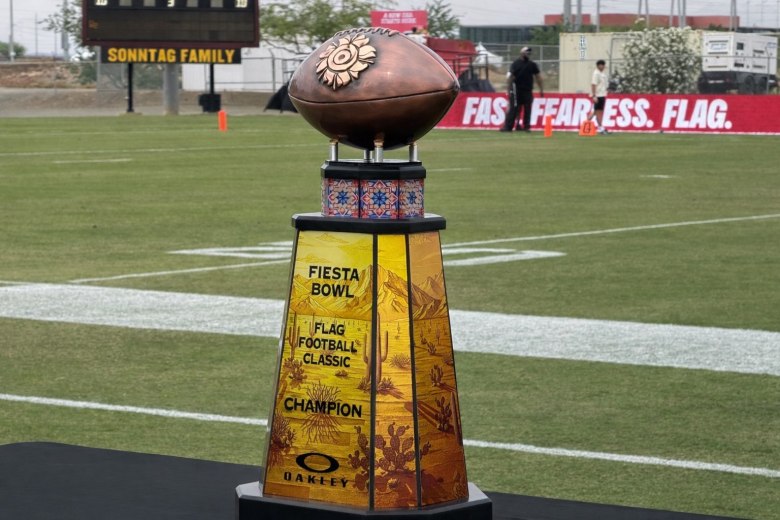
TEMPE, Ariz. — The dry heat of the Arizona sun didn’t stop eight college flag football teams from across the country from gathering for a weekend of nonstop, fierce competition in the inaugural Fiesta Bowl Flag Football Classic.
For a sport rapidly growing at the youth, collegiate and soon-to-be Olympic level, the outcome of the event, bearing the namesake of one of the most recognizable bowl games in college football, carried weight that went even beyond each team’s ultimate goal of winning the championship trophy.
Proof of concept
Over 140 student-athletes participated in 19 games across two days, with the semifinal games and championship game nationally televised on ESPN. Yet what unfolded over those two days extended greater than what box scores or streams alone could represent. Sure, competition was at the forefront of the weekend, but at the same time, it felt like a celebration. The event provided a sense of legitimacy — a glimpse of a larger future for what the sport could look like.
Countless corporate sponsors, a large media presence, a downtown hotel welcoming each team and large charter buses were just a few of the amenities provided to these athletes, most of whom had never seen these things before.
“This is absolutely insane,” Georgia wide receiver Nealie Cook said at Friday’s media day. “We are a club team that has to fundraise everything, and so this is just a blessing to us. We just walked in from the gear place, and our jaws were just dropped on the ground.”
Although the event carried a Division I label, Georgia and seven of the eight programs in the field still compete as club teams. Separated from their universities’ varsity athletics departments, these teams are student-run and student-funded, operating outside the traditional structure of NCAA varsity sports.
The eight-team field included Alabama State, Arizona State, Charlotte, Florida, Grand Canyon, UCF, USC and Georgia — with Alabama State serving as the only program competing as an officially recognized varsity sport. While the NCAA does not yet sanction flag football, the sport has been added to its Emerging Sports for Women program, with the goal of reaching full varsity status by spring 2028.
“If you told me back in 2023 that I would be playing at a Fiesta Bowl-style flag football tournament, I wouldn’t have believed you,” said Alia Pasternak, who founded USC’s club program — the final one invited to the event. “So it’s awesome to see, and especially how fast they put this together.”
While all the women at the event are pioneers, one in particular represents institutional success that stands in contrast to the “club team” origins of others in the tournament. Alabama State’s Kiona “Ki’lolo” Westerlund was the first athlete to ever receive a full-ride scholarship for flag football. After appearing in Super Bowl commercials and winning gold medals with USA’s Junior National Team, Westerlund’s presence at the Fiesta Bowl was another stage for her to once again be a trailblazer.
“My main focus is opening doors for younger athletes,” Westerlund told The IX Sports. “I’ve always been the kind of person that’s good under pressure. I like to do the hard things. I like to break down doors. I don’t want my younger siblings to have to go through the hard stuff, I want them to get all the opportunities that they deserve.”
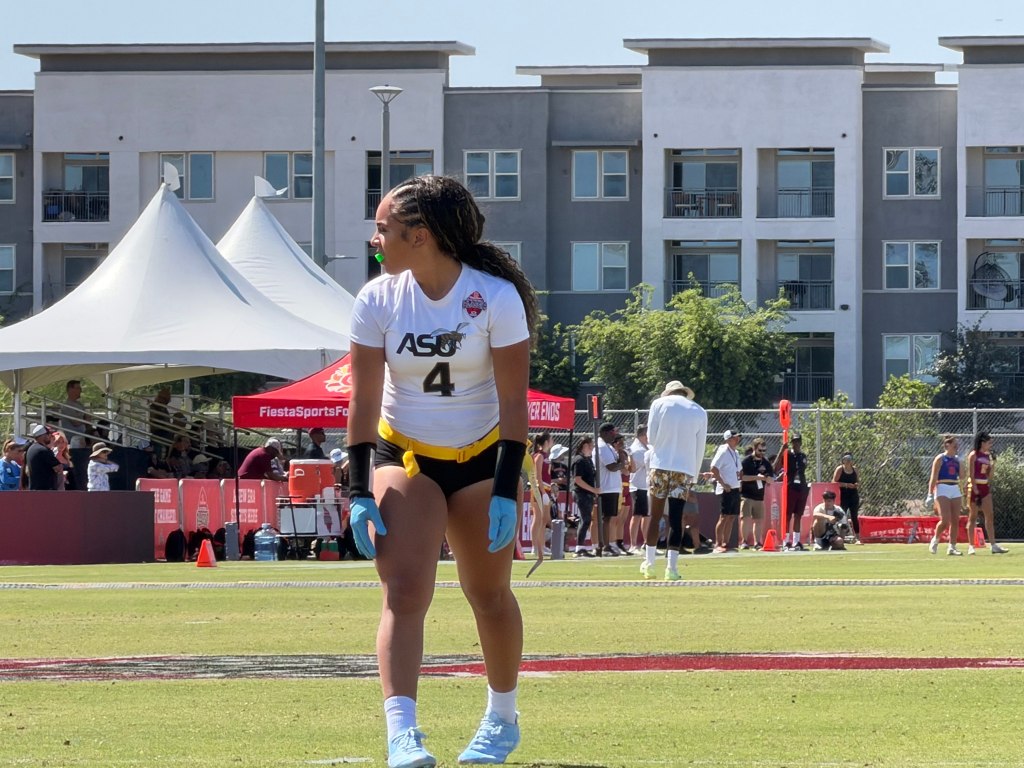
However, Westerlund’s path is still the exception, not the norm. Her scholarship is proof of how far women’s flag football has come, but for most of the athletes in Tempe, it also underscored how far the sport still has to go.
“The switch of being a club team to sanctioned is so very important because the sport is getting huge,” Westerlund said. “The Olympics are in 2028. I think that should be a big goal for these colleges. You should want to have Olympians at your school. You want to put your athletes in the best position possible.”
That level of institutional support is still out of reach for many athletes and programs at the college and high school level, even as the talent continues to rise. There are over 150 universities that offer flag football at a club or varsity level, with about 60 of them being recognized at the Division I level, according to a Fiesta Sports Foundation press release.
At the high school level, growth is even greater: 17 states have officially sanctioned the sport, with 20-plus others on the way. Participation has increased by more than 60 percent nationally over the past several years — millions of athletes are playing flag football. And of course, the 2028 Olympic Games in Los Angeles will feature flag football as a competitive medal sport for the first time. Still, more gasoline can be poured on the fire.
“We obviously have the skill, we just need the resources to enhance those skills,” USC’s Kyla Moore said. “Whether it’s certain equipment, access to certain facilities or if it’s money to help us grow even faster. Even just recognition. I know the NFL has some programs where they’re spotlighting different flag football teams, and that has helped. I think that has also helped to get it to the Olympics.”
To be clear, the lack of resources hasn’t slowed the sport’s growth — it has only made the journey to moments like this weekend more meaningful. Georgia’s Avery Scott remembers just how unlikely that journey once felt. During her freshman year, Scott and her Georgia CoRec team were on their way to one of their first big tournaments: the NIRSA National Flag Football Championship. A trip that was supposed to mark a milestone quickly turned into something far more chaotic and unforgettable for a different reason.
“I had gotten in a car crash,” Scott said. “I got hit by a drunk driver in the middle of Texas. I had stitches in my lip, another teammate got a concussion, but then we won the national championship. It was one of the craziest memories, something I would tell my kids about one day, you know? We just loved the sport and loved the bonds that it gave us. And so we want to extend this opportunity to more and more women.”
Now, despite being inactive for the weekend with an injury, Scott never stopped smiling on the sidelines as she watched and cheered on her Bulldog teammates. Now a senior, much has changed since that fateful day in 2023. The lights are brighter and the game is bigger, but the decision to start a team with her friends years ago has culminated with the deserving honor of being treated as a world-class athlete at the Fiesta Bowl Flag Football Classic.
“[Being here] is the most insane thing ever,” Scott said. “It makes me literally emotional. The cameras in my face and everything — I just never thought we could get here.”

Competition takes hold
By the time media day and pool play gave way to bracket competition, the tone shifted from celebration to urgency. Powerhouses like Florida, UCF, Georgia and Alabama State entered the weekend as favorites, while newer programs such as USC and Grand Canyon looked to measure themselves against the nation’s best. Charlotte and host Arizona State also considered themselves underdogs, but not without making noise of their own.
“Becoming Caitlin Clark” is out now!
Howard Megdal’s newest book is here! “Becoming Caitlin Clark: The Unknown Origin Story of a Modern Basketball Superstar” captures both the historic nature of Clark’s rise and the critical context over the previous century that helped make it possible, including interviews with Clark, Lisa Bluder (who also wrote the foreword), C. Vivian Stringer, Jan Jensen, Molly Kazmer and many others.
From the opening whistle, the energy was constant and unmistakable: players calling out coverages, signaling routes and celebrating every small win in a way that echoed across the fields. Charlotte nearly delivered the first shock of the weekend, mounting a comeback that fell just short against Alabama State. Arizona State followed with a statement of its own, knocking off that same Alabama State squad in a tightly contested seven-point game. And in one of the most dramatic turnarounds of the tournament, Florida erased a 14-0 deficit against Georgia to secure its spot in the championship.
Awaiting the Gators was a UCF team that had dominated from the start, outscoring its pool play opponents by a combined 85-7 to earn the No. 1 seed in bracket play. Still, there was no shortage of motivation for the Knights. The in-state rivalry carried weight, with Florida historically holding the upper hand — something UCF hadn’t forgotten.
In a championship game defined by defense and tension, every possession felt pivotal. Communication sharpened, sidelines leaned in and each Knights first down was met with UCF’s now-familiar chant, “that’s good enough for another UCF first down!”
In the final moments, with the outcome hanging in the balance, UCF delivered on back-to-back plays. An interception squashed Florida’s hopes of mounting a game-winning drive, and moments later, quarterback Kayla Ludwig broke free for a 44-yard rushing touchdown.

UCF’s monkey on the back that had been Florida was finally shed, as the Knights defeated their rival on the biggest stage to become the very first champions of the Fiesta Bowl Flag Football Classic. The final score was 19-7. Tears of joy flooded the faces of each Knights player as they hugged during the postgame celebration.
“We lost to [Florida] four years in a row, so this means so much to me,” said UCF linebacker/wide receiver Lindsay Ward, who scored a touchdown in the championship game. “It being my senior year, I couldn’t hope for a better outcome.”
More than a game
But as the final hugs were exchanged and the celebration began to settle, the significance of the weekend extended far beyond a single result. The growth of flag football is not just measured in championships or making an appearance on national television, but in the way the game is reshaping who gets to play it.
“One of the key things for us I’ve learned is that it’s the family and the dads seeing their girl play sports,” Florida assistant coach Brian Ridge said. “These girls that maybe didn’t have an interest in football before are suddenly watching Sunday football with their pops, saying, “Oh, look that’s a post and a go on the outside. Oh, they’re in Cover 3. Look at that Tampa 2 defense,’ Suddenly these girls can speak eloquently about the game, and probably even exceed their father’s knowledge.”
“There’s been a real focus on women’s sports,” he added. “I think people recognize that sports teach you lessons. These girls come in, they get new confidence, they get concepts of working hard at something. Team chemistry and things like that become important. So I think it really is fun to see them learn and I think simple lessons they’ll take with them will really pay off throughout their whole life.”
Opportunities like the Fiesta Bowl Flag Football Classic represent something that didn’t exist not long ago: a second chance at a dream that once felt out of reach. While powerful stories exist of girls playing on their high school tackle football team, many others never were never given the opportunity. No one knows that better than USC safety/wide receiver Jordan Schwesinger.
“I played flag football probably 15 years ago, and then all the guys started playing tackle football, so I played tackle too,” Schwesinger said. “I couldn’t play in high school, so I thought that was the end of my dream until now. I loved it and I wanted to keep playing, but there wasn’t quite a space for that yet. I just wanted any space to play football, so flag was an immediate yes for me.”
And for others, like Arizona State’s Rylen Bourguet, it’s about something even more personal — finally sharing in a tradition that, for years, felt reserved for someone else.
“My parents both graduated from ASU,” Bourguet said. “I had two brothers who played on the football team, one now coaches. Just to be able to represent ASU and have that last name on the back of my shirt, it’s a real experience to play football, just like my brothers, like my dad — it’s awesome.”
Moments like those, from family connections to second chances, are what gave the weekend its deeper meaning. The Fiesta Bowl Flag Football Classic was, on the surface, a tournament. But in a broader sense, it served as proof of concept: that the sport belongs on a stage like this, that the demand is real, and that the next generation is already watching.
Listen now to The IX Sports Podcast and Women’s Sports Daily
We are excited to announce the launch of TWO new podcasts for all the women’s sports fans out there looking for a daily dose of women’s sports news and analysis. Stream on Spotify, Apple Podcasts or anywhere you listen to podcasts, and make sure to subscribe!