When Ayami Sato took the mound to start the first game in Women’s Pro Baseball League history for the Los Angeles Queens on Aug. 1, she was expected to be one of the league’s dominant players. A 36-year-old veteran of professional women’s baseball in Japan and the Women’s Baseball World Cup, Sato was a three-time MVP of the latter tournament, a six-time gold medalist at the World Cup with Team Japan, the WPBL’s second-overall draft pick, and widely considered one of the greatest female baseball players of all time.
But before she recorded the second out of the first inning of that first WPBL game, she had surrendered five runs on six hits. Sato subsequently alternated between good outings and bad for most of this inaugural season. She gave up seven runs in three innings to the Heights in that first game, turned in one of the best starts of the season by any pitcher against the Firebells in her next outing (one unearned run in five innings), then gave up seven runs in four innings in a rematch against San Francisco. And on it went, flashes of brilliance mixed with frustration and disappointment.
Sato’s Queens had a similarly inconsistent season. After storming back to win that opening game 10-8 and starting the season 3-0 by defeating each of the three other teams, they dropped three straight against the Firebells to sink to .500 as San Francisco emerged as the league’s dominant team. Los Angeles remained a roughly .500 team for the remainder of the season, splitting their next four games, then alternating wins through the end of the regular season before going to a winner-take-all finale in both of their postseason series.
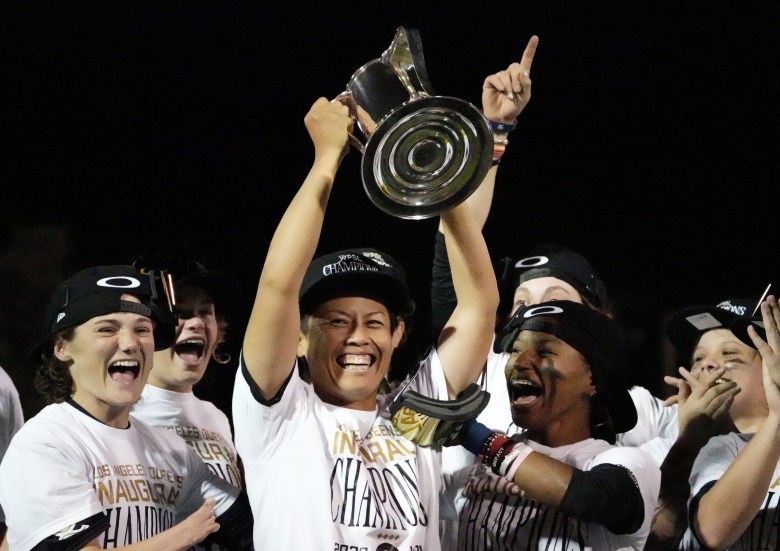
In each case, however, the Queens won their last game. In the regular season, they beat the Hunters in their final game to finish above .500 at 8-7, tying the Heights for second place on the basis of wins and losses. Against the Heights in the decisive third game of the semifinals, the Queens scored four runs in their final at-bat, just as they did against New York on Opening Day, to advance to the Championship Series. Tuesday night, in the winner-take-all Game 5 finale of the Championship Series, and the inaugural WPBL season, they won again.
This time, however, Sato live up to her reputation. In the biggest game in the young league’s history, Ayami Sato pitched the best game in the young league’s history, holding the same Firebells team that scored 27 runs in the previous two games scoreless while turning in the first complete game and shutout in league history, as the Queens won the game, 2-0, and the championship.
Sato said after the game that her pitch-to-pitch focus made it feel as though the game was moving slowly, but for the rest of us, it went by in a flash. Just one hour and 49 minutes, and just 71 pitches from Sato, was all it took for the Queens to claim the first championship in WPBL history.
Sato surrendered five hits, but they were all singles. She neither walked nor hit a batter, and her teammates played nearly perfect defense behind her. Sato allowed just one single per inning through the first four frames, retired the Firebells in order in the fifth, and didn’t allow a baserunner past first base until the sixth. That happened when third baseman Ashton Lansdell’s fielding error with two outs put runners on first and second instead of stranding yet another runner at first. Sato retired the next batter instead, then set San Francisco down in order in the bottom of the seventh to clinch the championship. No San Francisco player reached third base the entire night.
Despite Sato’s dominance, the Firebells’ pitching trio of Jill Albayati, Niki Eckert, and Liz Gilder was nearly as good, and by some measures better. Collectively, they allowed just two hits, both by center fielder Mo’ne Davis, Albayati struck out four in her 4 2/3 innings of work, and the Queens only managed to get a runner past second base in one inning. That one inning was the difference, however.
The only leadoff batter to reach base for either team all night, Queens first baseman Sarah Edwards led off the top of the third by drawing a five-pitch walk from Albayati. Diana Ibarra — who drew the start in left field as part of manager Eric Young’s defense-first lineup, a tactic that clearly paid off — then hit a first-pitch pop-up just beyond the infield dirt in shallow right center, where Robin Roberts Stadium’s turtleback field claimed its final victim of the season. Circling the ball, Firebells second baseman Amanda Gianelloni stumbled on the sharp slope at the start of the outfield grass, missed the catch, then kicked the ball away in her subsequent tumble, allowing both runners to scurry safely to their base.
Davis then connected for the Queens’ first hit of the night, and only hit of the inning, a clean single to shallow left that loaded the bases. With the infield playing in to cut off the run at home, shortstop Ayuri Shimano hit a hard line drive directly at first baseman Andréanne Leblanc, only for the ball to ricochet off Leblanc’s glove, again allowing all the runners to advance safely, giving the Queens a 1-0 lead.
Captain Ashton Lansdell then followed with a hard ground ball to the right of Firebells shortstop Joely Leguizamon, who made a nice play to cut down Davis advancing to third, though another run scored on that play, resulting in the only RBI of the game. With third base now empty, Albayati retired the next two batters on groundouts without another run scoring.
And that was it. That was all of the scoring in the entire game. A walk, a single, two errors, and a fielder’s choice: 2-0 Queens. And so it would remain, thanks to Sato, but thanks also to Eckert and Gilder, who combined for 2 1/3 scoreless frames, the former stranding two inherited runners with two outs in the fifth.
Game 5 was not only the first shutout by a single pitcher (Sato), it was the first shutout of any kind in the WPBL. No team had been held scoreless before, and the lowest-scoring game in league history prior to Tuesday night was the Hunters’ 6-1 win over the Heights way back on Aug. 13.
Asked what was so different about this game, Firebells manager Matt Williams noted that, for the first time all season, the wind was blowing in and the temperature at the ballpark was chilly. Tuesday was, after all, the first day of autumn, and it’s true that the handful of deep fly balls that each team hit all settled comfortably in the gloves of the opposing outfielders.
Gianalloni told reporters after the game that she thought her team “hit well, we just hit it right at them.” That’s not necessarily sour grapes. Sato only struck out one batter and walked no one. Of the 25 batters she faced, 24 put the ball in play, but 19 of them had those balls turned into outs (two of them for double plays). The quality of that contact wasn’t always as Gianelloni suggested, but it is true that the margin in this game was vanishingly small.
Listen now to The IX Sports Podcast and Women’s Sports Daily
We are excited to announce the launch of TWO new podcasts for all the women’s sports fans out there looking for a daily dose of women’s sports news and analysis. Stream on Spotify, Apple Podcasts or anywhere you listen to podcasts, and make sure to subscribe!
Young’s decision to go with his best fielders may well have been the difference. As it turns out, Ibarra didn’t record a single putout in left, but Amira Hondras — returned to second base from right field, pushing Ayuri Shimano to shortstop and Caitlin Eynon to designated hitter — converted six outs off the bat, including all three outs in the sixth inning when the Firebells pushed their lone runner into scoring position, and was involved in two double plays, giving her a hand in nine of Sato’s 21 outs. Counting those double plays, Shimano had a hand in eight of the 21 outs.
On the other side, Lansdell agreed that the change in weather was among the reasons this game felt different, “I mean, it’s the last game of the World Series, basically. Everything’s going to feel a bit different, a little bit more intense.”
For her part, Sato credited her struggles during the regular season with her success in the postseason, the latter of which included a total of nine scoreless innings in the two winner-take-all games. As she told reporters, via her translator, “I was one of the pitchers who gave up a lot of hits in this league, but because I experienced those failures, I was able to learn a lot about the hitters, their tendencies, and where their hitting zones were. That helped me understand the hitters much better going into the postseason. Because I failed so many times, I was able to learn from those experiences and make adjustments and improvements.”
Maybe it’s fitting, then, that the team that won the first championship in WPBL history wasn’t the dominant Firebells, who, even with this loss, went 14-8 (.636) on the season as a whole and outscored the Queens 40-29 in this series despite getting shutout in one of the five games and losing three of them.
Maybe its fitting that it was the Queens, the self-described underdogs led by an underdog manager, a team that made adjustments throughout the season, including the season’s lone trade, that out-prepared the Heights in Game 1 of the semifinals, then outfought them in Game 3, that entered this series as a clear underdog only to jump out to a 2-0 lead, get stomped 27-9 in the middle two games, then flip the script entirely with a shutout in Game 5. Maybe it’s correct for that team to be the champions.
Because this league is full of fighters. Full of underdogs. Full of players who were told they were too small, too slow, too weak, or told they had the talent but still couldn’t play baseball just because they were girls. Because this league is full of the players who were told all of those things and refused to listen. Because this league is full of Queens, and full of queens.
Ashton Lansdell seized on that characteristic of her team in speaking to reporters after the game, but she just as easily could have been describing the WPBL as a whole, all four of its teams, its 12 coaches, and all 69 of the players who appeared in a game this year, as the 18 players and three coaches that make up the Los Angeles Queens.
“Every single one of us on the roster, even on the coaching staff, they’ve doubted us in some way, shape, or form, and we take that to heart. And it’s a little chip on the shoulder, and we gotta show up and show out, because they don’t think that we can do it. And here we are. We did it.”
Damn right they did.
Notes:
Ayami Sato was named the Championship Series MVP. In two appearances, she posted a 3.27 ERA, striking out six against four walks in a team-high 11 innings and earning the win in Games 2 and 5. She primarily earned the award for her unprecedented performance in Game 5, of course.
Two other Queens who might have received consideration for the award were Maggie Foxx, who played catcher and right field and was the team’s best hitter at .474/.500/.684 with a team-leading six runs scored; and infielder Ayuri Shimano, who hit .294/.478/.471 with seven RBI, six stolen bases in as many attempts (both team highs), a Game 1 grand slam, and started Game 4 on the mound (albeit with disappointing results).
The hitting star of the series was Firebells shortstop Joely Leguizamon, who hit .500/.471/.875 with three doubles, a home run, and a team-leading seven RBI. The Firebells’ pitching star was Ela Day-Bédard, who posted a 1.59 ERA in 5 2/3 innings over two relief appearances.
The road team won all five games of this series and also scored first in all five games. There were no runs scored in the seventh inning in any of the five games. Despite being shut out in Game 5 and winning just two of the five games, the Firebells outscored the Queens in the series 40-29.
Manager Eric Young said that he held a team meeting at the hotel on Monday but didn’t make a big speech. “I didn’t want anybody to get on the bus,” Young told reporters after Game 5. “I didn’t want them to go far. I wanted to make it short and sweet, to the point, and then get off your feet … have a nice dinner, get some rest.”
One reason Ashton Lansdell was feeling so run down after Game 4 is that, she finally confessed to reporters after Tuesday’s game, she’s been “battling a sickness for the last two to three weeks now. I’ve been coughing my butt off, on and off the field.” She added that, “I actually went to a legitimate doctor and got some antibiotics. I got some legit medicine, and it’s working now, so I am feeling better.”
In presenting the championship trophy, Commissioner Justine Siegal noted that the silver pitcher was made in 1920, the same year that the 19th amendment was ratified, giving women the right to vote.
The Queens had their champaign celebration on the field, which I thought was a nice twist on the usual clubhouse celebration. There were logistical reasons for that, of course, but beyond being easier to clean up, it enabled the fans still in attendance (and this game was very well-attended) to enjoy the celebration.
At the end of her interview following the on-field trophy presentation, Ayami Sato said she had one more thing to say, then shouted into AJ Andrews’s microphone, in English, “Enjoy baseball!” Done and done.
‘Rare Gems’ is out now!
Howard Megdal, founder and editor of The IX Basketball and The IX Sports, wrote this deeply reported book. “Rare Gems” follows four connected generations of women’s basketball pioneers, from Elvera “Peps” Neuman to Cheryl Reeve and from Lindsay Whalen to Sylvia Fowles and Paige Bueckers.
If you enjoy Megdal’s coverage of women’s basketball every Wednesday at The IX Sports, you will love “Rare Gems: How Four Generations of Women Paved the Way for the WNBA.”