Among last week’s updates to the PWHL rulebook for the 2026-27 season is an interesting little experiment the league is conducting over the course of the preseason. The trial rule reads as follows:
- When a minor penalty is assessed during the overtime period, the non-offending team will have the option to take a penalty shot instead of a power play opportunity.
- A power play in overtime would continue to result in a 4-on-3 player advantage for the non-offending team, consistent with standard league rules. Should the non-offending team opt for a penalty shot, it may be taken by any eligible player in the lineup.
- All 12 preseason scrimmages will have a 3-on-3 overtime period (followed by a shootout), regardless of the score.
My initial reaction was …okay? Penalty shots are exciting. Penalty shots in overtime are even more exciting. It’s certainly got the hype factor that sold people on the Jailbreak Goal. It’s an interesting concept, fairly harmless save for when an entire fanbase questions their coach’s life choices whenever it goes south. But is it too harmless? Will it have enough of an impact to justify its existence? Or is this just innovation for the sake of innovation after the league took a season off from innovating following the No Escape Rule?
Somewhere around there is when something clicked for me, and I knew it was time to start manually collecting a whole bunch of data.
The Numbers
There have been 76 games over the first three PWHL regular seasons that have gone past regulation time. Teams have played a total of 252:54 of overtime hockey, which has decided 48 games while the other 28 have required shootouts.
Nine of them had a penalty called in overtime.
Well, that’s not a great start, is it? Officials swallowing their whistles late in close games in a misguided attempt to not affect the outcome is a well-known phenomenon. It severely limits the data we have access to. Perhaps the rule’s implementation will have a subconscious impact on the refs’ willingness to make calls in overtime, but psychology isn’t exactly my strong suit.
Before combing through the examples we do have, though, it’s important to go over the scenarios in which this choice of a power play or penalty shot in overtime would come into play.
The Use Cases
Your team draws a penalty late into overtime. Almost certainly the most common application of this rule. There’s next to no consequence for blatantly committing an infraction late enough into the extra frame for your opponent to be unable to set up on a power play. The option of a penalty shot disincentivizes taking the penalty in the first place. It also gives the action of drawing the penalty much more potential for value. PWHL teams’ all-time OT power play efficiency sits at 29.4%. That number rises to 50% when given the full two minutes to work with in the extra frame.*
*Remember this statistic. It comes up again later.
The situation favours your team’s best shooter over your opponent. It’s open-ended, but that’s what specifically fascinates me about the concept. The less obvious the decision between a power play and penalty shot becomes, the more of an expression of good scouting, coaching, and instinct it has the potential to be. How has your shooter of choice historically fared against this particular goalie? Is your opponent’s penalty kill more of a concern than their shootout track record? Does Kirsten Simms want it? There are so many considerations that can go into this binary choice. How wildly they vary based on game state makes it all the more interesting.
You don’t have faith in your power play. Yes, I could have put it more charitably, but this does pretty much tie the other two together. The further from the end of overtime you get, the more of a balancing act it becomes to determine how much leeway you’re willing to give your power play before taking your chances with the penalty shot. Who knows, if the PP/PK mismatch is bad enough, foregoing the full two minutes might even seem palatable.
With that established, it’s time to revisit some of the previous nine overtime penalties. Let’s see how those situations would have changed, if at all, if the teams in question had this rule at their disposal.
The Applications
03/16/2024: PWHL Ottawa @ PWHL Boston
Penalty: D. Watts (OTT), Delay of Game, 4:49 of OT
Likely Shooter: H. Brandt (BOS)
Goaltender: E. Maschmeyer (OTT)
Hilary Knight opens the scoring at Little Caesars Arena. Time is a flat circle. Anyway, Ottawa tied the game up on an Emily Clark power play goal, and the score held for the rest of regulation. With time winding down in overtime, Emerance Maschmeyer makes a kick save on Jamie Lee Rattray. With Susanna Tapani (wearing #88, good times) bearing down on the rebound, Daryl Watts instead chucks it clean over the glass.
You can’t ask for a more perfect application of this rule. A penalty with eleven seconds left before time expires, and a delay of game call at that, is exactly what it’s meant to be a deterrent for. Shooter/goaltender matchup be damned, you’re taking this penalty shot. Somewhat fittingly, the easy decision ends up an inconsequential one, as Boston would win the shootout regardless.
02/23/2024: PWHL New York @ PWHL Toronto
Penalty: S. Nurse (TOR), Hooking, 3:18 of OT
Likely Shooter: A. Carpenter (NY)
Goaltender: K. Campbell (TOR)
On the other hand, this scenario could plausibly go either way. While it wouldn’t be a full two minute power play, 1:42 is more than enough to get something done with. New York had a top two PP in the PWHL for the inaugural season. Kristen Campbell has the best shootout save percentage among all PWHL goaltenders who have faced at least five attempts. That said, the Toronto penalty kill they’re facing is the best in league history, plus New York had just won their previous game in a shootout with Alex Carpenter converting.
Even the hindsight perspective is conflicted on this one. Toronto eventually won this game with Campbell stopping Carpenter in the shootout. While getting to end it in OT is alluring to New York, who’s to say it doesn’t end the same way? With all the available evidence in mind, I’m ruling in favour of taking the power play. I certainly wouldn’t have faulted a team in this position for choosing otherwise.
01/28/2026: New York Sirens @ Boston Fleet
Penalty: J. Rattray (BOS), Tripping, 3:50 of OT
Likely Shooter: K. Kaltounková (NY)
Goaltender: A. Frankel (BOS)
Why hello, 2025-26 New York Sirens power play, we meet again. Like the last example, I wouldn’t necessarily question a team taking the power play here, but I have too many trust issues at this point not to lean penalty shot. While the Sirens netted a goal with the player advantage earlier in the game, it’s still a 10% PP against a 90% PK, with only a little over half the allotted time to work with.
The other reason I’m taking my chances on the individual effort is the individual in question. Kristýna Kaltounková entered this overtime period already with two tallies, putting her up to eight goals in her last eight games. She’d also beaten a goalie on a penalty shot in that stretch (though she didn’t beat the post). Kalty’s probably the single best player you could put this game on the stick of, and if she walks it off for her hat trick? Instant heritage moment.
01/14/2024: PWHL New York @ PWHL Minnesota
Penalty: B. Hobson (NY), Holding, 3:20 of OTLikely Shooter: G. Zumwinkle (MIN)
Goaltender: C. Schroeder (NY)
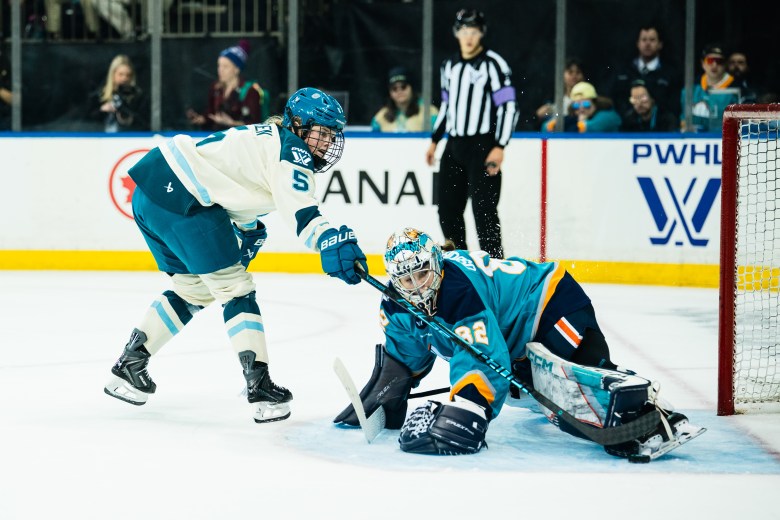
This is undoubtedly the best demonstration of what the rule would actually look like in practice. Brooke Hobson hauls down Grace Zumwinkle on the breakaway and the Minnesota forward gets the first penalty shot in league history, in overtime, in front of a home crowd of eight thousand. Alas, the cinema was closed. Corinne Schroeder turns her away with the blocker, play continues, and New York scores the winning goal less than a minute later.
Interestingly, we can now look at the application in reverse, even though the wording of the rule is ambiguous as to whether or not Minnesota would get to choose here. Would they turn down this penalty shot for 1:40 of power play time? Hindsight obviously says yes, but Minnesota’s PP was an abysmal 8.2% in the inaugural season while New York’s penalty kill was pushing 90%. If it were up to me, this game would play out exactly how it did.
The Rebecca Leslie Edge Case
Remember that league-wide overtime power play percentage stat I said would come up again later? Well, it’s later now. Leslie’s OT winner on December 23, 2025 against the Toronto Sceptres introduced a pesky new variable to the equation for the first time: late third period penalties carrying into overtime. Jesse Compher was sent off for holding at 19:37 of the final frame, and Leslie’s power play marker came at 1:24 of OT.
She then proceeded to do it again. March 22, 2026, Abby Roque gets booked at 18:27 of the third, and Leslie sends the crowd home happy just twelve seconds into overtime. There are two goals of this nature in PWHL history, and she has both.
Or does she?
The Nicole Gosling Edge Case to the Edge Case
Through one illegal hit on April 17, 2026, Shay Maloney managed to not only blindside Dara Greig, but also me while doing research for this. The refs call the penalty at 20:00 of the third period, somehow creating a full overtime power play whose infraction didn’t actually take place in OT. Montréal started the extra frame with 2:00 on the penalty clock, and Gosling ended the game 38 seconds in.
The reason I have these scenarios separate from the others is because teams wouldn’t get to exercise the option for a penalty shot, since the penalties in question were assessed in the third. In regards to the new rule, all they serve to do is skew the percentages outlined earlier. Removing these three goals as well as the six unsuccessful partial power plays, PWHL teams now operate at 25% on the PP in OT overall and 40% with the full advantage. Still good, no doubt, but slightly worse on both fronts.
The Verdict
This rule is fun. If it couldn’t already be gleaned from my prose, I had a blast writing about this potential new aspect to PWHL hockey. Discouraging penalties in the dying seconds of OT is a function that serves a greater purpose than given credit for, and the situations it applies to are extremely intriguing.
That said, the situations in question have arisen in just 3.2% of this league’s games, and would have had a meaningful effect on the outcome in even fewer. I’m under no illusions that the ability to pick between a power play and a penalty shot in overtime is going to fundamentally alter the landscape of the PWHL.
But it’s fun. And I really don’t think it’s an issue if that’s all it ends up being.