The Boston Fleet are shipping up to their namesake city full-time.
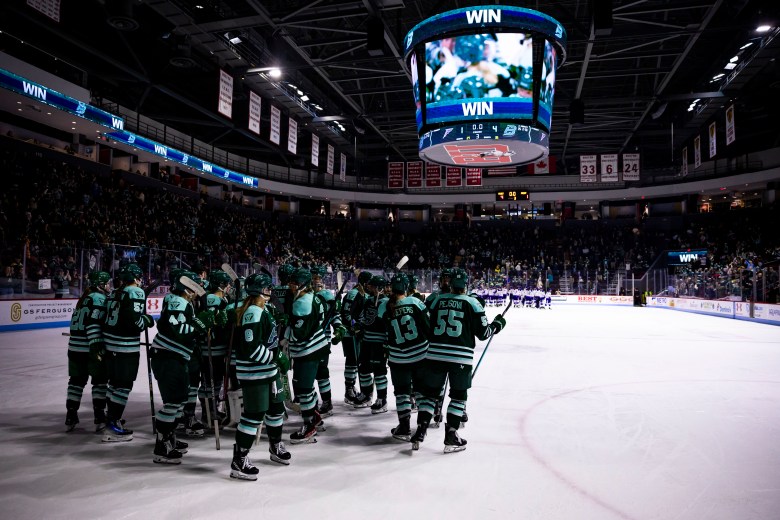
The Fleet will call Boston University’s Agganis Arena their primary home next season after three seasons at the University of Massachusetts-Lowell’s Tsongas Center, the team announced today. The Fleet have played six games at Agganis over the past two seasons, with four resulting in sellouts.
“The passion for the Fleet in the City of Boston has continued to grow since our first game at Agganis, and this move allows us to build on that momentum while creating new opportunities to connect with supporters throughout Greater Boston, the South Shore and Rhode Island,” said Boston Fleet Director of Business Operations Laura Marie Davey in the press release.
The move brings the Fleet into Boston proper full-time after spending the last three seasons located 30 miles north. The commute from Boston was difficult, with it often taking at least an hour and a half during rush hour.
The long commute from the nearest major city likely played a major role in the Fleet’s lower weeknight attendance. However, Agganis Arena is located just off the MBTA Green Line in the heart of Boston. In contrast, Lowell is on the MBTA commuter rail, which mostly runs every 40-60 minutes on weekdays and every two hours on weekends. However, the schedule was not favorable, with fans often having to either leave weekday games early or wait for the last train of the night, which left after 11 p.m. In addition, Tsongas is more than a mile from the Lowell station in a not overly walkable area. Public buses ran from the station to the arena on weeknights, but they stopped running before the final horn.
Looking at attendance, Boston drew a total of 32,948 fans to Agganis, for an average of 5,491 fans a game. They played four weekday games, with three sellouts, along with a weekend sellout plus a weekend game over 5,000 fans. In addition, they sold out their TD Garden debut this past season, with 17,850 fans turning out. Meanwhile, their regular-season attendance at the Tsongas Center over the past two seasons is 86,711 (19 games), for an average of 4,563 fans. 12 took place on weeknights, with one sellout during their lone Friday night home game. Meanwhile, two others cracked 5,000 fans. However, three of their seven weekend games sold out and three others surpassed 5,000 fans.
Long-term, the move to Agganis is likely the right decision. The arena size is similar, but the fanbase growth potential is greater in Boston. Their ability to attract casual fans will improve, as will their ability to get fans through the door on weeknights. However, this is a devastating move for the passionate core fanbase that has developed in Lowell. It is just as difficult for Lowell area fans to get to Boston as it is for Boston area fans to get to Lowell. As a result, the Fleet will undoubtedly lose many of their current season ticket holders. That might lead to some attendance issues next year outside of weekends and “big” weekday games while they rebuild their core base of in-person fans. However, it’s hard to imagine the team will not recover in the following seasons.
All things considered, this is an enormous move that comes with plenty of perks, but also some drawbacks. However, there have been rumblings since the inaugural season that the PWHL has wanted to play at BU, as they had the city’s most available arena. Now, it’s reality, putting an end to the annual offseason question of where Boston will play the following year. The Fleet are now anchored in Boston, likely for good.