In a three-day span in August, the Harvard, Dartmouth and Columbia women’s basketball teams all took off for foreign tours. Harvard left on Aug. 9 for Croatia and Greece, and Dartmouth left the same day for Portugal, Spain and Gibraltar. On Aug. 11, Columbia flew in the other direction, to Japan.
Foreign tours have become less common for Division I women’s basketball teams over the past few years. In 2023, at least 58 Division I teams took foreign tours, including 33 power-conference teams. Last summer, at least nine teams traveled, and the same is true this summer.* Most teams that traveled over the past two summers are mid-majors, in part because power-conference teams may be spending money differently with the introduction of revenue-sharing in 2025.
However, foreign tours continue to be valuable experiences for Ivy League teams for several reasons. The Ivy League does not participate in revenue-sharing, so its teams can’t distribute the money they spend on foreign tours to players instead. Foreign tours can help with international recruiting, as overseas prospects can potentially see Ivy League teams play in person and Ivy coaches can deepen their overseas connections.
And crucially, the Ivy League does not allow summer practices — unless a team is taking a foreign tour, in which case it can have five practices before departure. So foreign tours give Ivy League teams a jump start on the season and help them catch up a little bit to teams in other conferences, while also giving players a potentially once-in-a-lifetime experience.
“The transformation over the transaction, I think that’s what the Ivy League experience is,” Columbia head coach and alum Megan Griffith told The IX Sports in September. “… We’re never going to be a revenue-sharing league. It’s just not what the league is about. But we can create amazing experiences for our student-athletes that are going to serve them for the rest of their lives.”
“For us to continue to provide that type of experience at least once every four years, to me, is really important,” Harvard head coach Carrie Moore told The IX Sports in August. “… There’s a lot of reasons why [players] choose this place, but there are some things that maybe they’re missing out on to a certain degree. And so I think this type of trip is also a thank-you to them for choosing Harvard and … going against the grain, because not everybody does it, and not everybody can do it.”
Here’s a behind-the-scenes look at each Ivy team’s foreign tour this summer. You can read them all or skip to your favorite team using the links below.
Columbia | Dartmouth | Harvard
Your business can reach over 3 million women’s sports fans every single month!
Here at The IX Basketball and The IX Sports, our audience is a collection of the smartest, most passionate women’s sports fans in the world. If your business has a mission to serve these fans, reach out to our team at BAlarie@theixsports.com to discuss ways to work together.
Harvard: Croatia and Greece, Aug. 9-19
As Moore was deciding where to go for her first foreign tour at Harvard, she drew inspiration from other teams’ travel photos. “Everything that I saw [of Croatia] … just looked spectacular,” she said.
She also liked that Croatia was a less common destination than France, Italy or Spain — places her players may have gone with their families or have high on their bucket lists. And then Greece, the home country of junior point guard Lydia Chatira, was a quick flight and an easy addition.
For Moore, it felt like this foreign tour came at a pivotal time for the program. This is her fifth season at Harvard, so her first recruits — Mary Hollensteiner, Karlee White and Abigail Wright — are now seniors.
“There was so much, obviously, that we were focused on doing in our first couple years, just with hitting the ground running, building and recruiting, and retaining staff and players,” Moore said. “And … I just felt like it was kind of a good segue, a good transition point for this group to travel and spend time and grow together and learn about each other, in hopes that it allows us to accomplish some really special things this upcoming year.”
In the practices leading up to the tour, the coaches didn’t focus heavily on specific drills or plays. Instead, they wanted the players to get comfortable playing in different lineups and situations, and they tried to build everyone’s confidence. They were “kind of taking away the fear of making mistakes, fear of failure,” Hollensteiner told The IX Sports in September, “and just getting us back to playing.”
The Crimson have been known for their pressure defense under Moore, and this year, they want to use that pressure to help them play faster on offense. Moore believes one of their biggest strengths this season is their shooting, so she wants them to sprint up the court and get the first good shot they can. The 24-second shot clock overseas helped reinforce that.
“Every coach says, ‘Well, we want to play fast.’ It’s like, ‘No, but really,’” Moore said. “… If you look back at the stats, we haven’t played fast. … [But] I feel like anyone that watched us in Europe can see the difference.”
White and Wright were Harvard’s leading scorers last season, led the way on the court overseas, and will anchor the team again this season. There is also plenty of depth around them with players like Hollensteiner, Chatira and reigning Ivy League Rookie of the Year Olivia Jones.
In addition, Moore was hoping one of the three first-years would surprise her on the tour, and Australian guard Sierra “CC” Woolhouse did just that. Moore praised Woolhouse’s defense, shooting, and speed with and without the ball, but also her intangibles, like her grit and confidence.
Moore believes the foreign tour will benefit the team because it checked off several milestones that wouldn’t normally happen until September, October or November.
“We’ve already had a lot of firsts: our first team meeting, our first practice, our first lift, our first game,” she said. “… So I really hope these guys can hit the ground running based on the confidence that they’ve been able to build.”
Harvard also got to enjoy its first homecoming of the season. The coaching staff tries to get at least one game close to players’ hometowns in their careers, if they’re from the United States but outside the Ivy League footprint. The foreign tour gave Chatira a similar experience.
The Crimson played one game at the gym where Chatira grew up playing for the Greek club team Agia Paraskevi. That gym was also where her parents had grown up playing and had first met. During a pregame ceremony honoring her, Chatira smiled and wiped away tears as she felt her career come full-circle.
“I will remember this game forever … and I’m very thankful to [the club] for the ceremony they had for me,” Chatira said in a video Harvard posted on social media. “It was amazing. It was great playing here again … [in] a very familiar gym to me.”
“I think it was just such a testament to the work that she’s put in, how far she’s come, and also just what opportunities basketball can give you,” Hollensteiner said. “… It was really incredible to witness it, and [it] just made me really happy for her to get that experience because I know all of us American players will get brought home at some point.”
The team also spent an evening at Chatira’s house, playing cards and eating Greek food that her mother cooked. Chatira’s father DJed for everyone in the basement for nearly two hours and capped the night by breakdancing.
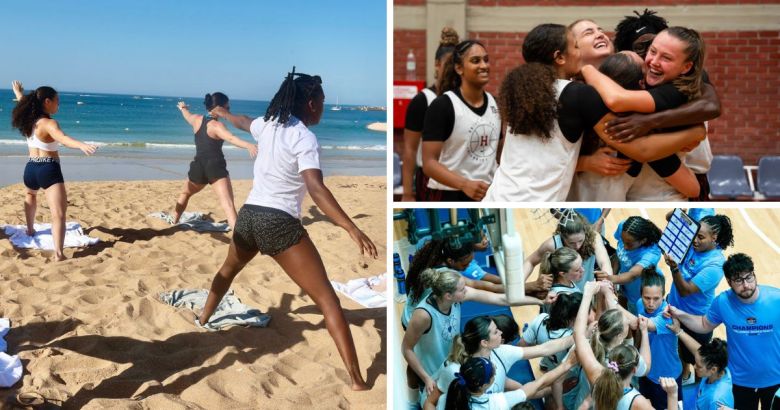
The Crimson found opportunities to dance in Croatia, too. They spent a day at an orphanage, where they taught the children TikTok dances, learned some Croatian dances from them, made bracelets with them, and played soccer and basketball. Moore wanted her players to have that experience so they would feel more connected to the local community, rather than only being tourists.
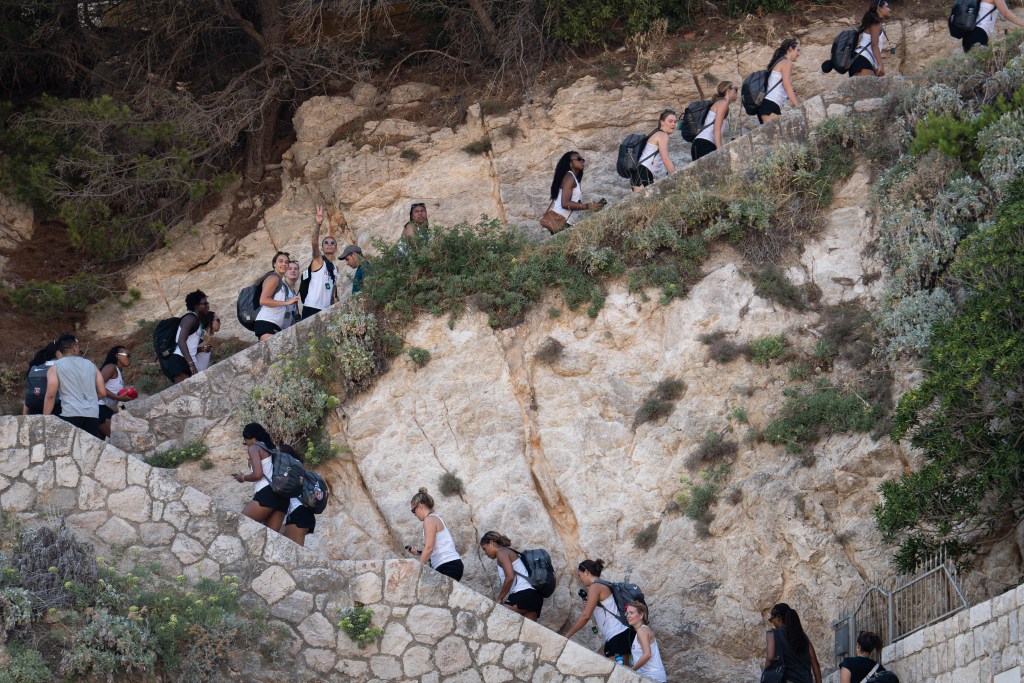
Other highlights of the trip included: a walking tour of Dubrovnik that covered several places where the television show “Game of Thrones” was filmed; a bike ride in Split with views of the Adriatic Sea’s “Gatorade blue” water (in Hollensteiner’s words); and a day on a boat in Athens that Moore said was among the best days of her life.
Perhaps most importantly, the way the trip went validated for Moore that she’d recruited the right people to Harvard.
“I felt like it was an aha moment of, ‘OK, we’ve really hand-picked these people to be here, and there’s a reason for that,’” Moore said. “And you could see it come to life in the 10 days that we were traveling together. They love one another to the 1,000th degree. … They can have fun doing just about anything together. It can be the smallest, most mundane thing, and they’re going to find the joy within it. And to me, that is what makes this program so special is just the culture of how they act and interact with one another.”
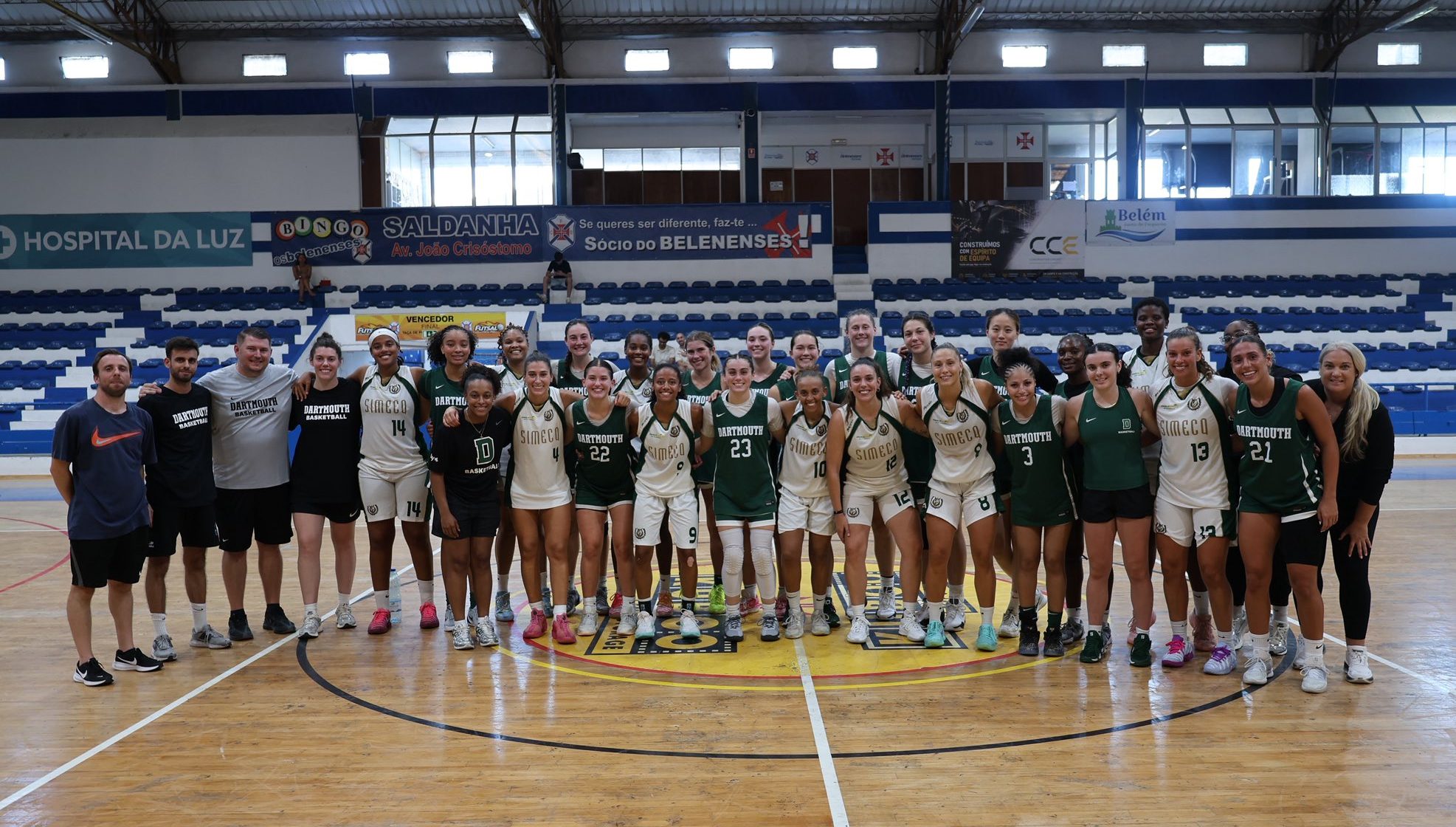
Dartmouth: Portugal, Spain and Gibraltar, Aug. 9-20
When Dartmouth head coach Linda Cimino told her players about the foreign tour, she said she had good news and bad news. The bad news was that they’d have to return to campus early from summer break. The good news was the reason why.
It was the first foreign tour in program history, funded by an anonymous donor. Cimino wanted to take a foreign tour because she believes it will help the program take the next step back toward championship contention. Because Dartmouth is on the quarter system, its fall classes — and therefore its preseason practices — don’t start until mid-September each year. So combined with its lack of summer workouts, it likely has the shortest preseason in Division I.
“If we could get extra practices on the court and go play some games, and then also experience the culture and team camaraderie off the court, would this help us win a couple of games next year?” Cimino told The IX Sports in August. “Would this put us in position to become a better program? And the answer was yes. So this donor didn’t just invest in the experiences, but he invested in our student-athletes and what we’re trying to build.”
Instead of hiring a tour company, Cimino chose to plan the trip herself, using her extensive contacts and knowledge from over a decade of international recruiting. She did a five-day test run where she scouted potential gyms to play in and negotiated hotel contracts in person.
One of Cimino’s rules for team travel — whether domestic or international — is no checked bags besides the athletic training equipment. That’s because she never wants to show up somewhere and find that the team’s bags didn’t make it. So the players each packed a duffel bag and a backpack, and Cimino fit everything she needed into just a backpack.
The Big Green played four games overseas, which is more than many teams play. That allowed Cimino to experiment with her roster, which was especially important because neither of her point guards was available to play and Dartmouth is implementing a new transition offense this season.
In the first game, Cimino decided to start as many of the first-years as she could.
“I was like, ‘Let’s see what our recruiting class looks like today. You five are starting,’” she said. “And they all kind of looked at me like I was crazy.”
In each game, Cimino tried out different players at point guard. Sierra Carson, a 5’8 senior guard, told The IX Sports she played everywhere but center on the trip, which helped her “get reps in … in all aspects of the game,” including being a vocal leader for a new group.
According to Cimino, forward Catherine McDonald was “by far” the team’s best player on the trip. McDonald went from the Big Green’s seventh-leading scorer as a sophomore to their second-leading scorer as a junior, averaging 8.8 points and 6.7 rebounds per game last season. Junior guard Magda Freire, a Portugal native and a transfer from Queens University of Charlotte, also impressed by hitting several 3-pointers in front of her home crowd.
But the leadership Dartmouth got up and down the roster was perhaps the most important takeaway from the trip.
“Everyone was being a leader on and off the court,” Carson said. “It doesn’t need to be vocally — we were talking about that — but just finding your role early on. And I think that’s a huge thing of this whole experience … because we have such a short preseason and we’re starting school right then. This was just time to focus on the basketball aspect and building that chemistry on and off the court.”
Rep The IX Sports at your next game!

Shop the logo collection or special “Women’s Sports are Front Page News” collection now on Shopify.
One memorable day off the court came in Madrid. The team spent the morning at the Museo Reina Sofía, an art museum focusing on the late 1800s to the present. Thomas Beischer, the father of first-year guard Anna Beischer and a professor of architectural design and history at Stanford, joined the team in Madrid and guided the group through the museum. Then in the evening, Dartmouth watched the Atlético Madrid men’s soccer team beat Malaga in its season opener.
“It also goes to show you what a Dartmouth student-athlete is,” Cimino said. “… We experienced [the museum] in the morning and then we flipped the switch, just like if you were [on campus].”
The Big Green also spent time in Gibraltar, a British territory on the southern border of Spain. They walked across the border on foot, which involves crossing the runway for Gibraltar’s airport.
“You’re like, ‘This is crazy. A plane just lands here or takes off,’” Carson said. “But … it feels like a normal walk. But then when you really take it in, you’re like, ‘Whoa, this is surreal. You’re just walking from one country to another.’ And technically we were like, ‘Oh, we’ve been to three countries in three days,’ which is just an amazing experience.”
In Gibraltar, they got to interact with Barbary macaques at the Rock of Gibraltar. Many players held them, and one scampered up Carson’s back, leaving footprints on her white dress. “I was like, ‘OK, never washing this now,’” she said. A different monkey climbed on Cimino’s head, and another decided to investigate the inside of the team’s bus.
To Cimino, the trip was the perfect blend of work and play to help the Big Green improve this season.
“Big picture, we came home better,” Cimino said. “We came home better connected, more experienced, with a better understanding of who we are as a program and where we want to go. I think we learned some things about our basketball team. We learned about each other. …
“When you’re trying to build something special like we are, these experiences help the process. I know our players will remember the games, but they’ll probably remember monkeys on their heads more.”

Columbia: Japan, Aug. 11-21
When Griffith has taken Columbia overseas, she has generally wanted to do something different than the norm. In 2022, that meant traveling to Morocco and Spain while most other teams went solely to Europe. This summer, she chose Japan. Columbia has connected with a lot of alumni in Asia in recent years, and the destination also appealed to Griffith on a personal level because her mother was born and raised in Hong Kong.
“It was sort of a trifecta of cultural immersion, [a] once-in-a-lifetime experience and then the alumni relation piece,” she said. “And then my personal family touch really helped push me over the edge.”
In the practices before the trip, Griffith and her staff focused on teaching concepts, particularly defense and breaking pressure. They emphasized making quick decisions and knowing the time and score, and they worked to get all the players comfortable with each other, even the returners. Last season, starting guards Marija Avlijas and Fliss Henderson were injured throughout Columbia’s run to the WBIT title, and reserve-turned-starter Mia Broom shone in an expanded role. So developing chemistry between those three and returning Ivy League Player of the Year Riley Weiss was top of mind.
Listen now to The IX Sports Podcast and Women’s Sports Daily
We are excited to announce the launch of TWO new podcasts for all the women’s sports fans out there looking for a daily dose of women’s sports news and analysis. Stream on Spotify, Apple Podcasts or anywhere you listen to podcasts, and make sure to subscribe!
The Lions played two games overseas against college-level teams and a third against the Japanese national team. The latter came about with help from former Columbia guard KJ Matsui, who has played for the Japanese men’s national team. The game took place at the national teams’ training center, which was originally created to prepare Japanese athletes for the 2008 Olympics.
The Lions beat the college-level teams and narrowly lost to the Japanese national team, and Griffith said she was pleased with how they adjusted to the pace of play.
“The Japanese style is extremely fast,” she said. “Everybody could shoot. It’s like, I mean, they are running laps around you. … And the shot clock’s [shorter], so obviously they’re just playing faster anyways. And there’s no media timeouts. Like, the game is just moving at light speed.”
Junior forward Mary Ashley Stevenson, a transfer from Purdue and Stanford, told The IX Sports in September that facing the Japanese style of play helped pressure-test the Lions’ defense.
“This Columbia women’s basketball team prides itself on defense,” she said. “… We have a lot of offensive firepower, but being able to work together as a team on defense is something we learned a lot about in Japan, especially because the players are quite a lot faster and a lot smaller than we’re typically used to. … So [we were] focusing on, what are our defensive principles and how can we translate that kind of early in this process?”
After the game against the national team, Griffith and Matsui spoke on a panel about their experiences at Columbia and with basketball in Asia. The Lions players and staff, the Columbia University Alumni Association of Japan, and the American School in Japan all attended the event.
While the Lions have a deep group of returning guards, they graduated their starting frontcourt of Perri Page and Susie Rafiu. Enter Stevenson, who Griffith said fit right in with the team in Japan.
“It’s so hard to transfer into a program, especially the older you are, because … you’re mature as a basketball player, but everything’s new again,” Griffith said. “So there’s just this strange disconnect. But I thought she really did a great job. … She was just so hungry to get coached, which I love.”
Griffith also praised how her three first-years caught up to where the program is after such a successful 2025-26 season, likening that challenge to boarding a moving train. She has now taken the Lions on three foreign tours since she was hired in 2016, but this was her first where first-years and transfers were allowed to travel, following an Ivy League rule change in 2024.
She has been mindful of giving the team extra rest in years when preseason effectively starts in July or August rather than in September. But she’s excited to see this season how much the trip will put her whole team — not just the returners — ahead of the curve.
“There’s things that we now know that probably would have taken us the first month, and now we can adjust and build the team into a healthy way back into practicing,” Griffith said. “… So I think we’re just gonna be ready to really attack and not have any surprises … like you kind of do in a preseason.”
Among the highlights for the Lions off the court were seeing several historic temples and shrines in Kyoto, getting to make their own matcha as part of a traditional Japanese tea ceremony, and visiting the Hiroshima Peace Memorial Park and Museum.
Hiroshima “was, I think, extremely impactful, especially being from New York City [and] at Columbia, which has so many … connections to the creation of the atomic bomb,” Stevenson said. “And that I think hit a lot of us really hard.”
They also rode on Japanese bullet trains, which can go up to 200 miles per hour, and finished the trip with a karaoke night.
“I don’t think anybody’s winning ‘The Voice,’” Griffith quipped before shouting out first-year guard/forward Mathis Dritz as the most frequent singer that night.
When the Lions flew home in late August, they brought back a mantra that they’ll lean into this season: “Ichi go, ichi e,” which translates to “one time, one meeting.” It’s a reminder, Stevenson explained, to stay present and connected, even when things get hectic.
“The Japanese way of life, the respect, the gratitude, the ‘we before me,’ it’s like so many things that we preach culturally to our program,” Griffith said. “And being great ambassadors of something bigger than yourself, we talk a lot about that with Columbia, but to represent your country and play against the national team, see the pride that they have in what they’re doing … there’s just this great respect for the place and the country that I think will carry with our team for quite some time.”
* Through 2025, data on the number of teams taking foreign tours is based on The IX Sports’ outreach to tour companies. 2026 data is from publicly available team press releases.