Stay tuned for a look at why you should be excited about PWHL San Jose’s offense later this month.
Picture this: It’s the middle of January 2027. You’re reading by the light of a candle after Santa Clara plunged the Bay Area into darkness trying to turn off its substations after every 49ers starter came down with an injury in the first two months of the season. Your trip to the SAP Center takes twice as long as it used to now that Northern California has banned using “miles” to measure distance after the Valkyries were swept by Minnesota in the playoffs to fall to 1-11 all-time against the Lynx.
And despite rookie defender Laila Edwards scoring 7 goals in her first 12 professional games, PWHL San Jose has been shut out five times and sits last in the standings, averaging an abysmal 1.25 goals per game. At the SAP Center, PWHL San Jose fans have embraced LMFAO’s “Shots” as an early anthem in an effort to spark the team’s offense.
This bleak scenario probably won’t happen (however, if you’re a South Bay resident, there’s no harm in keeping a spare flashlight around), but it stems from an uncomfortable truth: PWHL San Jose’s forward group is the league’s least proven.
By the numbers
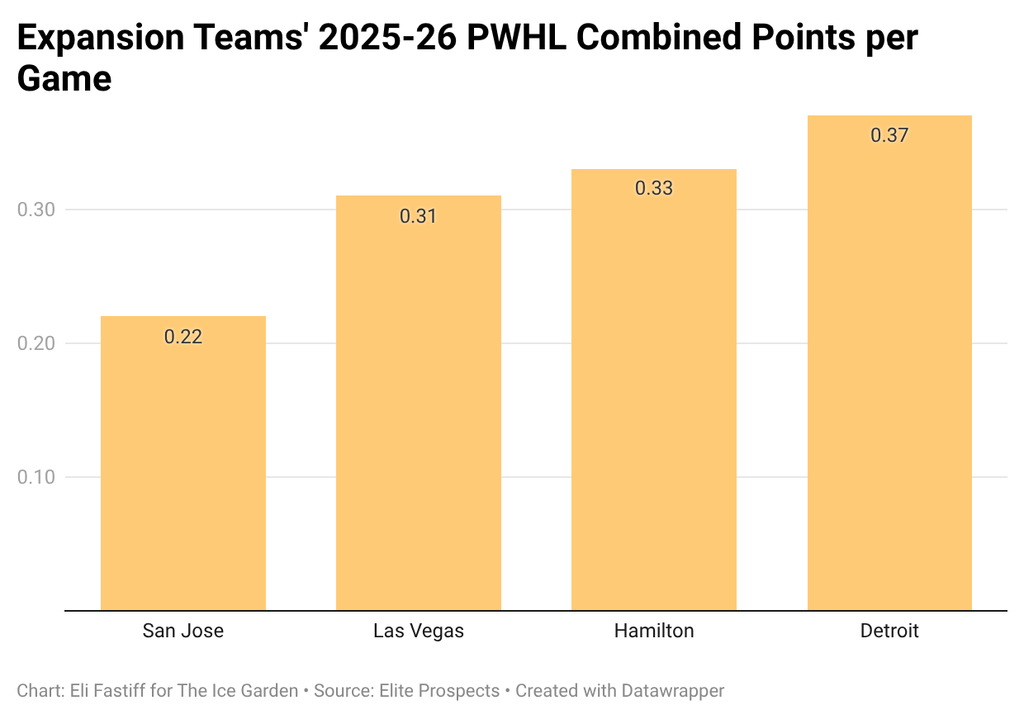
San Jose currently rosters 11 skaters (seven forwards and four defenders), who played a combined 288 games during the 2025-26 PWHL season. Together, they totaled 20 goals and 43 assists, or 0.22 combined points per game.
To put that number in perspective, compare the other expansion rosters: Detroit’s squad has 14 returning players who yielded a combined 0.37 points per game (51 goals and 70 assists) last season. Hamilton’s 13 skaters averaged 0.33 (38 goals and 82 assists). Las Vegas’ 12 averaged 0.31 (28 goals and 58 assists).
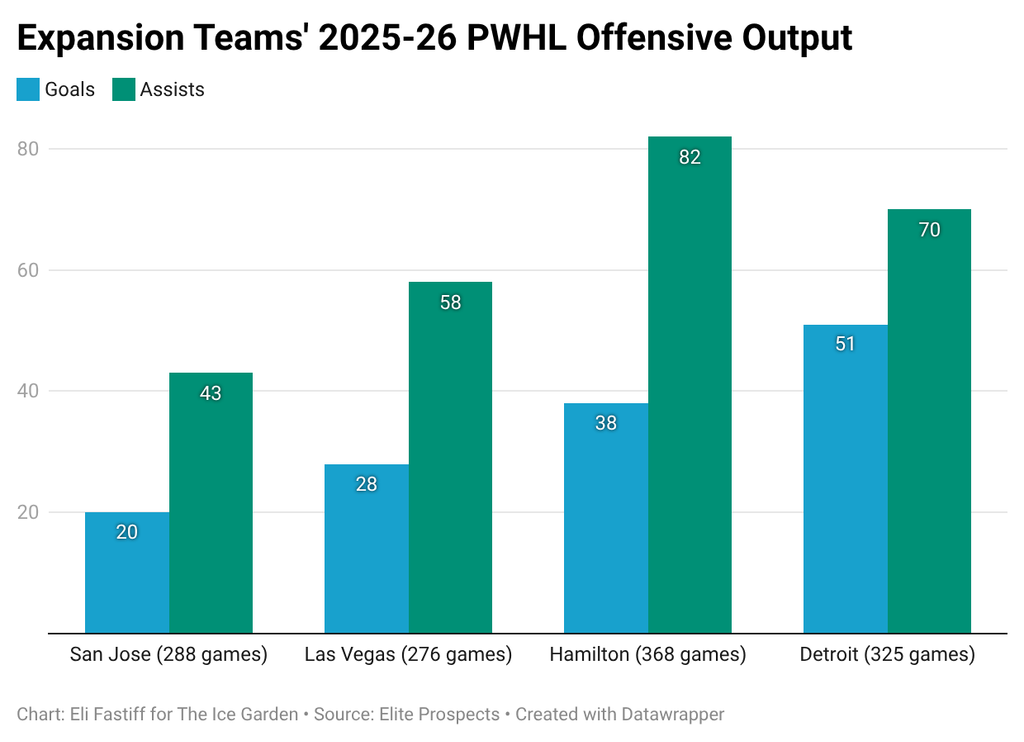
In summary, San Jose’s roster averaged nearly a third fewer points per game last season than the next-lowest expansion team (Vegas) and scored almost half as many goals last season as two expansion teams (Detroit and Hamilton).
The biggest driver of this offensive discrepancy comes from double-digit scorers. Detroit, for example, has two players who scored more than 10 goals and four with more than 10 points last season. Las Vegas is the only expansion team other than San Jose without a 2025-26 double-digit scorer (Hayley Scamurra leads the team with 8), but it also has a trio of skaters who tallied 15 or more points last season.
San Jose’s best goal scorer from last season was Natálie Mlýnková, who scored 5. San Jose has just two players that reached double-digit points: Mlýnková and Maddi Wheeler. They each tallied 10.
Removing the team’s four defenders from the equation doesn’t help. Outside of Mlýnková and Wheeler, San Jose’s five other forwards combined for 9 goals in 116 games.
What’s to blame?
Head coach/general manager Troy Ryan and glass-half-full fans might argue that these numbers don’t tell the real story about San Jose’s offense. They might assert that the lack of previous goal-scoring is due to a lack of opportunity — players being either placed in ill-fitting roles on weaker teams or buried on third and fourth forward lines — and youth.
These arguments have some merit. For example, five of San Jose’s forwards will arrive after playing on either the Sirens (Anne Cherkowski, Wheeler and Kristin O’Neill) or the Sceptres (Maggie Connors and Kristin Della Rovere) — who, respectively, had the second-worst and worst offenses last season.
Even Mlýnková — who played for the league’s second-best offense in Montréal — managed just 10 points and spent the championship series buried on the Victoire’s fourth line.
For players like Cherkowski, Mlýnková, Connors and others who had recent collegiate success, new settings and a difficult adjustment to professional hockey could explain their underperformance. This youth runs throughout San Jose’s roster. The squad is the youngest in the PWHL by nearly a full year — the team’s average age is 25.15 — and 28-year-old O’Neill is two years older than the next-oldest skater.
Optimistically, the youth shows there is room to improve and grow as players gain PWHL experience. But in the near term, this extreme reliance on youth could make PWHL San Jose’s inaugural season one defined by growing pains.
Rookies
While Edwards declared for the draft as a defender, her presence — regardless of position — in San Jose’s five-skater draft class bodes well for the team’s offensive future. Add in 44-point scorer Sloane Matthews (Ohio State), 43-point scorer Lily Shannon (Northeastern) and 2024-25 Hockey East Player of the Year Reichen Kirchmair (Providence) and there’s a lot to like about this group.
But this is not an optimistic article. Outside of Edwards, there are questions about how much offense the team’s rookies will contribute right out of the gate. While Matthews’ success in the strongest college hockey conference bodes well, Shannon’s and Kirchmair’s numbers came playing in Hockey East, a steeper talent drop from the professional level. That isn’t to say that the pair won’t find professional success, but it may take them longer to adjust. And, outside of Edwards, no San Jose rookie skater has senior international experience.
Final thoughts
San Jose’s offense is built on potential. It’s built on the premise that the team’s young forward corps can reach that potential in a new setting with a new coach. And it’s built on the hope that Ryan’s team-building emphasis on creating a unified on-ice identity over on-paper skill will help San Jose avoid the first-year expansion struggles that Seattle and Vancouver faced.
Unfortunately for fans of high-scoring hockey, San Jose’s identity will be a defensively sound 200-foot team, not an offensive juggernaut. There’s a chance that most of San Jose’s forwards find or refind their scoring touch. But there’s also a scenario in which the new team’s youth and lack of star power results in a frustrating inaugural season.