WASHINGTON — As one of the youngest teams in WNBA history, the Washington Mystics are considered a team with plenty of potential. But to player development lead Clinton Crouch, that’s almost a dirty word.
“If someone’s talking about your potential, that means you’re not good yet; you just look like you might be good one day,” he told The IX Sports in May.
Instead, he tells his players, “Let’s erase your potential.”
Closing the gap between where players currently are and where they could be is at the heart of the Mystics’ player development process, and player development has been their top priority all season long.
“Whoever’s on our roster, our commitment is full-out player development for everybody,” head coach Sydney Johnson told reporters at the team’s preseason media day on April 20. “… We will do that with every single person on our roster, regardless of age, experience, position, all that good stuff.”
The Mystics have done a good enough job at that to put themselves in playoff position, sitting in eighth place with a 19-14 record. Holding a six-game lead over the Portland Fire for the final playoff spot with 11 games left, they’ve firmly surpassed the external expectations for this season.
Here is a behind-the-scenes look at how the Mystics staff has approached player development and how the players have responded.
How the Mystics develop players
When a new player joins the Mystics, whether in the offseason or midseason, the first step in their development is evaluating their strengths and weaknesses. To do that, Crouch and the rest of the staff lean on analytics and film. If it’s midseason, the film tends to be clips rather than full games. But if there’s time, assistant coach Barbara Turner likes to see more.
“If I have time up front, I like to watch games just to see how they move and how they do things in game and how it aligns with what the numbers say,” Turner told The IX Sports in July. “And then … we assess how we can fit that into our team.”
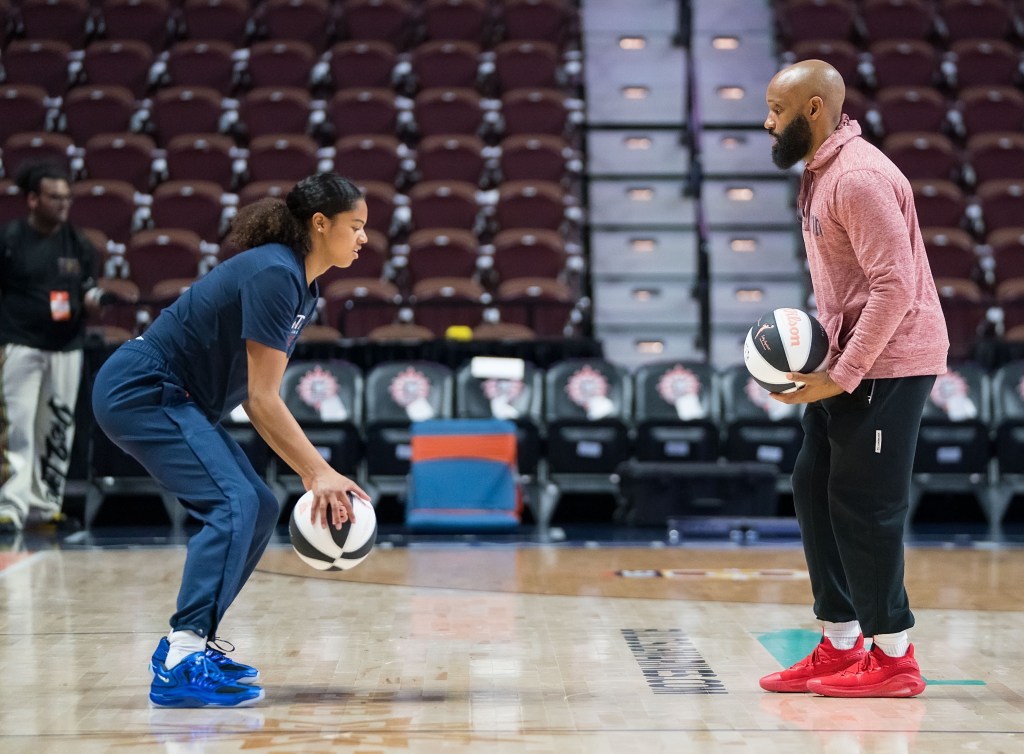
Each of the Mystics’ players is assigned to a specific development coach, and throughout the season, they get near-daily work in with that coach. That work includes pregame warmups, film sessions and small-group meetings. It also includes the Mystics’ daily “vitamins,” which are 15- to 30-minute sessions before practice that focus on individual development.
“I really think that us having the vitamin system has really helped us in terms of having a young team,” Turner said, “because we’re able to hone in and pinpoint on the small details that young players may miss.”
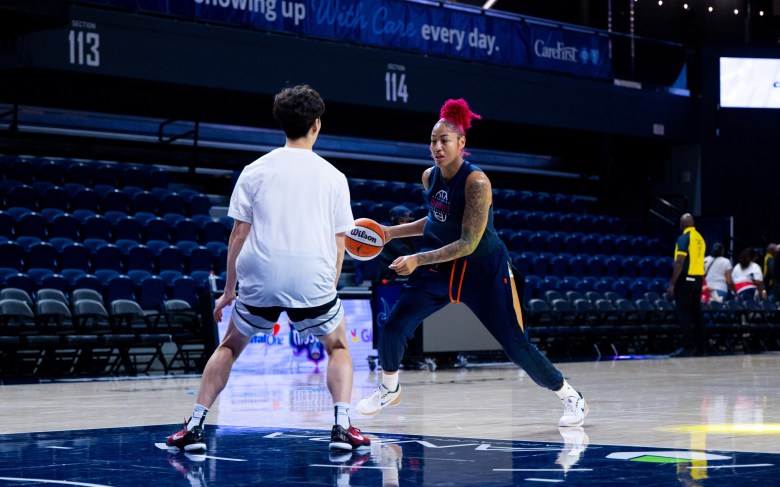
Each player’s vitamins look different, but for second-year forward Kiki Iriafen, her sessions with Turner generally start with form shooting, then progress to whatever skill or nuance Turner wants to focus on that day. After that, Iriafen tries out that skill against one or more of the team’s male practice players.
“My favorite part is when I get to play live against a practice player in my vitamin,” Iriafen told The IX Sports on Aug. 7. “… The live action — whatever you learn, you get to apply it in that same session — I think is really great for me.”

The staff also has check-ins with each player before the season starts and every 10 to 15 games during the season. In those meetings, they discuss how the player is doing relative to certain targets. Sometimes they adjust the targets or the approach they’re taking.
“We have player development plans that are really analytically driven, and I think that helps to see the numbers,” veteran forward Michaela Onyenwere told The IX Sports in July. “[It’s] like, ‘Hey, you are getting better here, or you need improvement here,’ and it’s not subjective.”
As part of those meetings, the coaches want to hear the player’s perspective, to make sure the plan is working for her. And they’ve created a culture where it’s always OK to ask questions, both in meetings and on the court.
“It’s a very open space for me to be able to talk to [Johnson] about my concerns or, ‘OK, I don’t know what that is,’” developmental player Darianna Littlepage-Buggs told The IX Sports in June. “… One of our identity pieces is open, direct and honest communication. So I think that’s just a really big thing that he likes to push, too. He’s like, ‘If you don’t know it, just let me know.’”
Listen now to The IX Sports Podcast and Women’s Sports Daily
We are excited to announce the launch of TWO new podcasts for all the women’s sports fans out there looking for a daily dose of women’s sports news and analysis. Stream on Spotify, Apple Podcasts or anywhere you listen to podcasts, and make sure to subscribe!
On game days, the Mystics help the players translate skills from practices to games by giving them live reps in warmups. After small groups of players warm up their shooting, they take a few minutes to play against the practice players. It generally starts with three players on offense against three practice players in the half court. The player who scores comes off, along with her defender, so the next rep is 2-on-2, followed by one-on-one.
“[It’s] just an extra tool to help prep you for the game and kind of what you’re going to see,” veteran center Shakira Austin told The IX Sports on Aug. 7.
Turner first got the idea for those live reps while working with the South Bay Lakers, an NBA G League team. She has put her own spin on it in Washington, drawing on her WNBA playing experience.
“As a player … you just feel more comfortable when [it’s] like, ‘All right, I just worked on this,’” she said. “… The light bulb immediately goes off, and I think for young players, the light bulb going off a lot is really, really important, because … they’re still learning the small details and the nuances of the professional level. So putting them in pro settings and putting them in situations where they have to think is super valuable.”
For players who don’t get a lot of game minutes, there are often additional reps with practice players before or after games. That’s partly to help them stay ready in case they’re called upon for more minutes, but it’s also to help them develop the decision-making skills they need as pros but aren’t getting many chances to work on in games.
Ultimately, the Mystics staff believes in every player on the roster, even though each one has different strengths and is at a different point in their development. The approach is personalized, but the goal for everyone is the same: Be consistent in doing the work and get a little bit better every day.
“Every time we come out, whether it’s in our practice gym, on the road [or] in our home gym to play, it’s always an opportunity to turn the page,” Johnson said in July. “… You just always [have] an opportunity to prove yourself and to learn more and to seize the day.”
The players have embraced development
Last season, Iriafen and then-Mystics guard Jade Melbourne pointed to extra workouts with Turner — dubbed “Breakfast Club” — as a key component of their development. This year, Iriafen said, “We kind of have whole-team Breakfast Club now.”
The players worked hard last year to improve their games, too. But with eight rookies on the roster this season, there’s another level of development that has needed to happen, and everyone has bought in. Focusing on one day at a time isn’t a cliché in Washington; it’s how the players have committed to approaching the season.
“I feel like [development has] become part of our routine,” rookie guard Cassandre Prosper told The IX Sports in July. “… It’s really every day, daily reps.”
The vitamins are popular among the players. Austin likes that they’re before practice because it feels better for her body to start small in the vitamins, build into full-group live play in practice and then be done for the day. Onyenwere appreciates how the work in the vitamins directly applies to games, and second-year guard Sonia Citron values how personalized they are.
“It really is a time to not really work on team stuff, but work on exactly what you need to work on as an individual, which is different for everybody,” Citron told The IX Sports on Aug. 5. “So it just kind of gives you that time to — not be selfish, but work on what you need to work on.”
Much of the reason the Mystics have been able to exceed preseason expectations is that they are applying what they’ve worked on in vitamins and practice directly to games and learning from game to game. That’s helped their defense be one of the WNBA’s best — a rarity for a young team — and set a franchise record with 12 blocks in a win over the Atlanta Dream on Aug. 7.
“Seeing [my teammates] all just working out every day, really trying to get better, and then seeing them do stuff in the game that I see them practice is just really cool,” Citron said.
“As the season’s gone on, we’ve just got better, more mature at finishing games,” Austin told reporters after a win over the Seattle Storm on July 12. “… So just being able to learn through those mistakes, learn through the games, wins and losses.”
And collectively, the young Mystics are eager to be great WNBA players. After they gutted out a four-overtime win over the Fire on June 28, Johnson said he had the best job in the WNBA because his players are “giving their all, absolutely everything” and “have never, ever, ever stopped maxing out what we ask them to do.” Similarly, Turner told the players after a July practice that their relentlessness even after making mistakes stood out to her.
“Their intent to want to be good is high-level already for a young group,” she said.
As a result, Turner never worries about overloading them with film. All she sees is players wanting more information and asking more questions.
Crouch sees that same hunger, but sometimes he breaks up individual film sessions with a few clips of a player they grew up watching, or even edits from a movie or a cartoon. That’s because joy is part of the Mystics’ ethos, too.
After all, this is a team whose performance staff suggested beginning a July practice with a game of dodgeball, and Johnson and Crouch even joined in. It was both fun and competitive, which is the mix that has fueled the Mystics’ development all season.
How do the Mystics determine success?
Games are the clearest way for the public to gauge how things are going for a team. But for the Mystics, they’re only a few data points. Practices and other workouts count for a lot, too, especially for players who aren’t regulars in the rotation.
Evaluating success starts with Johnson’s two non-negotiables: Are the players being tough, and are they sticking together?
After that, the staff leans on a mix of the eye test and analytics to assess the team’s progress. The Mystics track every shot taken on their two practice courts, so they have statistics on how each player is doing in practice, not just games.
In games, the coaches often look for whether players are applying the skills they worked on in recent vitamins and whether they’re making new mistakes or repeating ones from past games. Progress isn’t always linear for players, games have ups and downs, and new skills don’t always immediately translate to games. But the coaches try to reinforce the good whenever they can while correcting the bad.
For example, when rookie point guard Alicia Flórez missed a layup against a practice player in warmups on Aug. 5, she put her head in her hands in frustration. But assistant coach Jessie Miller immediately praised her for the hard crossover she’d done to set up the layup in the first place.
“When they do have those small moments, you highlight it for them so that they can know, like, ‘All right … I didn’t do it right six times, [but] I got it right [on reps] 7, 8, 9,’” Turner said in July. “‘So now I can build off 7, 8, 9.’ So thinking of it that way.”
The coaches can approach it that way because they have a big-picture outlook in mind, too. While they focus heavily on the details of the development process, they know it’s counterproductive to put too much weight on a single day’s results.
“They’ve got to go through the fire, and so whether that’s against other teams and how they’re being played, different schemes, different reads, but also … having a good game, maybe having a bad game,” Johnson said. “All of that is part of their growth, and what I love about our organization and our coaching staff is that we’re weathering that storm with them. … We’re not riding the highs and lows of results. We’re really committed to stacking days.”
Your business can reach over 3 million women’s sports fans every single month!
Here at The IX Basketball and The IX Sports, our audience is a collection of the smartest, most passionate women’s sports fans in the world. If your business has a mission to serve these fans, reach out to our team at BAlarie@theixsports.com to discuss ways to work together.
Cataloging the wins
There are just four players in the rotation who are not rookies and have been with the Mystics all season: Austin, Citron, Iriafen and Onyenwere. All four are averaging career highs in minutes per game, points per game, assist-to-turnover ratio and player efficiency rating. They’ve also all totaled career highs in win shares, showing how their improvements have helped the team.
| Minutes per game | Points per game | Assist-to-turnover ratio | Player efficiency rating | Win shares | |
|---|---|---|---|---|---|
| Shakira Austin (5th season) | 29.7 | 16.7 | 0.87 | 20.0 | 3.2 |
| Sonia Citron (2nd) | 33.6 | 17.1 | 1.52 | 18.3 | 4.4 |
| Kiki Iriafen (2nd) | 28.1 | 14.7 | 0.93 | 18.6 | 3.2 |
| Michaela Onyenwere (6th) | 26.1 | 9.1 | 0.96 | 10.2 | 1.6 |
Take Austin as an example: In her fifth WNBA season, she has 14 double-doubles in 32 games. In her previous four seasons combined, she’d had 14 in 105 games. She’s been even better in seven games since the All-Star break, averaging 23.0 points per game on 52.1% shooting.
“She’s really impressed and added to her game, it seems like, week to week,” Johnson said after a game against the Las Vegas Aces on Thursday.
Austin and Iriafen have both extended their range, which has helped them not only be more versatile individually, but also play better together. Each of them has taken three times as many 3-pointers as they did last season, and Austin has been especially effective, making 37.0% of her threes on 1.4 attempts per game. Shooting threes instead of midrange shots was one of the Mystics’ main developmental focuses in the offseason for the whole roster, and though the team shoots a low percentage overall, it’s at least taking more threes than it did last season.
Onyenwere has been the Mystics’ best 3-point shooter, making a career-best 40.4% this season on 3.4 attempts per game. She said part of her development in her sixth WNBA season has been shifting her mindset to, “Hey, I am a shooter. I have to shoot in order for us to be successful.”
Meanwhile, Citron has struggled from 3-point range this season, but she has become more of a playmaker. She often runs the offense late in games as part of a lineup that has terrorized opponents in recent weeks, and her assist rate has climbed from 13.5% as a rookie to 20.8% this season.
“We started with a focus of having Sonia on the ball [at] the end of last season, going into the offseason, going into this year, and so her growth and comfort there is intentional,” Johnson said before Thursday’s game. “… It’s her work. It’s Crouch’s work. … It’s our whole organization seeing the value of having a player that we can help develop off the ball and with the ball.”

But it’s not only the veterans and high-minute players who have improved this season. Flórez went from a developmental player to the team’s backup point guard in about a month earlier this season. Littlepage-Buggs is transitioning from being a power forward in college to a small forward in the WNBA, and Turner said she’s no longer “a fish out of water.”
Even rookie point guard Rori Harmon, who hasn’t played more than three minutes in a game since May 18, is feeling good about her development. She has become a more confident 3-point shooter — and said all her teammates have noticed and encouraged her. She is also getting better at making reads at the pro level.
“There’s always ways to get better,” Harmon told The IX Sports in July, a few weeks before she was waived and re-signed to a developmental contract. “I know being in the game and being on the court is one way, but just watching Alicia, watching [starting point guard] Georgia [Amoore], watching them and … giving them knowledge or stuff like that. [I’m] just staying invested and just always being locked in because you really just never know when that time comes.”
Rep The IX Sports at your next game!

Shop the logo collection or special “Women’s Sports are Front Page News” collection now on Shopify.
As a whole, the young roster is gaining firsthand knowledge of what it takes to win at the professional level and how to approach a WNBA season. The players are also gaining a lot of confidence from the work that they’ve put in, and it’s only growing as the results follow.
“I can just tell team-wise, the confidence, especially from our rookies, [is different] from Game 1 to now,” Iriafen said. “… I think that’s something that has been really great for our team. … You can definitely tell when they go out there, they’re not scared. They’re very comfortable.”
“We respond to the daily challenge of being a Mystic,” Johnson said in June. “… I’ve been really, really pleased with the growth from day to day because it is about player development, from our young players to our oldest players on the roster with Mic and Kira. That’s who we are … and that’s the joy that we get from being in D.C.”
The IX Sports’ Michael Waterloo contributed reporting for this story.
Monumental Sports and Entertainment, the group that owns the Washington Mystics, holds a minority stake in The IX Sports. The IX Sports’ editorial operations are entirely independent of Monumental and all other business partners.